
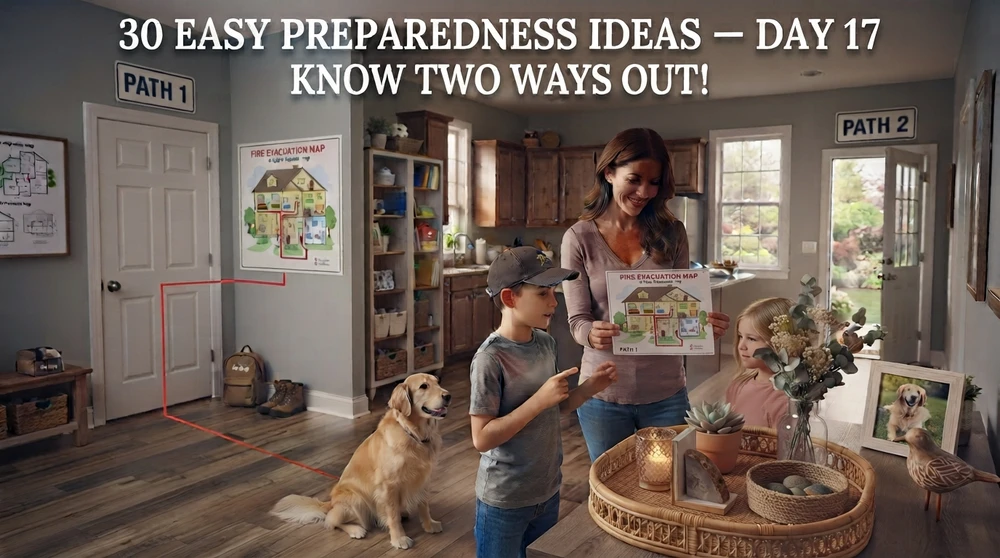
30 EASY PREPAREDNESS IDEAS — DAY 17 KNOW TWO WAYS OUT!
Posted by Mimi on Sep 17th 2026
30 EASY PREPAREDNESS IDEAS — DAY 17
KNOW TWO WAYS OUT!
Welcome to Day 17 of our 30 Easy Preparedness Ideas!
Yesterday we put one food away for the future.
Today?
YOU DON'T HAVE TO BUY A THING!
Today's preparedness challenge is completely FREE.
But it might be one of the most important things we've practiced this month.
We're going to answer one simple question:
IF YOUR NORMAL WAY OUT WAS BLOCKED...WHAT WOULD YOU DO?
Today we're going to find:
TWO WAYS OUT OF YOUR HOME
AND
TWO WAYS OUT OF YOUR NEIGHBORHOOD
Because sometimes...
PLAN "A" DOESN'T WORK.
That's why Mimi likes a PLAN B.
START INSIDE YOUR HOME
Most of us leave our homes the same way every day.
We walk through the same hallway.
We use the same door.
We pull out of the same driveway.
We don't even think about it.
But what if that normal exit couldn't be used?
Maybe there's:
- A fire
- Storm damage
- Structural damage
- Smoke
- Debris
- Another hazard blocking the usual path
Would everyone in the family know another safe way out?
THAT'S TODAY'S FIRST CHALLENGE.
FIND TWO WAYS OUT
Walk through your home together.
Start with the rooms where everyone sleeps.
Ask:
“If we couldn't use this door, what would we do?”
Look at your available exits.
Depending on your home, that could include:
- Front door
- Back door
- Side door
- Garage exit
- A suitable window as part of a fire escape plan
The appropriate exits will depend on your home.
DON'T JUST THINK ABOUT IT.
Walk through them.
Can the door actually open?
Is something blocking it?
Does everyone know how the lock works?
Could an older child operate it if necessary?
Is the path clear?
GET DOWN TO KID LEVEL
Here's something we adults sometimes forget.
WE KNOW HOW OUR HOUSE WORKS.
Little ones may not.
A child may know where the back door is but not know how to unlock it.
They may not be able to reach the lock.
They may think they're supposed to hide when they're frightened.
Or they may automatically try to find Mom or Dad instead of following the emergency plan.
That's why we practice.
Keep it calm and age appropriate.
Ask:
“SHOW ME TWO WAYS WE CAN GET OUT.”
Let them point them out.
Then practice walking to them.
A SPECIAL NOTE ABOUT FIRE
When we're talking about exits, fire deserves special attention.
If there's a fire:
GET OUT AND STAY OUT.
Once you're safely outside, don't go back inside for belongings.
Don't go back for your phone.
Don't go back for your favorite shoes.
Don't go back because you forgot something.
And as much as we love our animals, children especially need to understand:
NEVER GO BACK INTO A BURNING HOME TO FIND A PET.
Get outside and tell firefighters about pets or people who may still be inside.
Our belongings can be replaced.
PEOPLE CAN'T.
WHAT ABOUT WINDOWS?
In some rooms, especially bedrooms, a window may be part of your emergency escape plan.
Today is a good time to LOOK at those windows.
Can they open?
Are they painted shut?
Is furniture blocking them?
Is there a screen?
Is the window too high for a child?
Is it on an upper floor?
DON'T CREATE A DANGEROUS PRACTICE DRILL.
We're identifying and discussing escape options today—not having children climb out upper-story windows.
If your family's escape plan relies on special equipment such as an escape ladder, adults should learn how it is designed to be used and follow the manufacturer's instructions.
WHAT SHOULD KIDS DO?
Keep the message simple.
Something like:
“IF THERE'S A FIRE, WE GET OUT.”
And:
“WE MEET AT OUR FAMILY MEETING PLACE.”
We'll spend more time on meeting places tomorrow for Day 18.
For now, children should begin understanding that once they are safely outside:
THEY STAY OUTSIDE.
They don't run back in looking for Mom.
They don't run back for a toy.
They don't run back for the dog.
They go to the family's designated safe location and stay there.
WHAT ABOUT OUR PETS?
Our pets are family too.
Think about them as you walk through your plan.
Where are:
- Leashes?
- Carriers?
- Pet Grab-N-Go Bags?
Remember Day 8?
We already worked on those pet emergency supplies.
Adults can think through how pets fit into the evacuation plan without putting people in danger or delaying a necessary escape.
NOW LET'S GO OUTSIDE
We're not finished!
Most of us also leave our neighborhood the exact same way every day.
You probably have your favorite route.
Maybe it's the fastest way to work.
The easiest way to the freeway.
The road you could practically drive with your eyes closed.
But...
WHAT IF THAT ROAD WAS BLOCKED?
Flooding.
Fire.
Police activity.
Construction.
An accident.
Downed trees.
Debris.
A damaged road.
Or simply a LOT of people trying to leave at once.
DO YOU KNOW ANOTHER WAY OUT?
FIND TWO ROUTES OUT OF YOUR NEIGHBORHOOD
Today, look at a map.
You can use a paper map or your phone while planning.
Find:
ROUTE A
Your normal route.
Then find:
ROUTE B
Another way out.
Depending on where you live, you may even want a Route C.
Look for different roads that don't immediately funnel you back into the exact same bottleneck.
And remember:
YOUR BEST ROUTE WILL DEPEND ON THE EMERGENCY.
We're not choosing one route that works for everything.
We're simply learning our options.
DRIVE YOUR PLAN B
Here's your bonus challenge:
TAKE A FAMILY DRIVE!
Drive your alternate route.
This can actually be fun.
Tell the kids:
“Today we're finding another way out of our neighborhood.”
Where does the road go?
Where does it connect?
Does it dead-end?
Does it cross a bridge?
Does it lead somewhere you didn't expect?
You may discover that the road you've always assumed was your backup route...
ISN'T MUCH OF A BACKUP AT ALL.
That's exactly why we're checking now.
DON'T DEPEND ONLY ON GPS
I LOVE GPS.
I use GPS.
I'm certainly not suggesting we all go back to driving around with a giant paper map unfolded across the steering wheel.
But technology can fail.
Your phone battery can die.
Cell service can become overloaded or unavailable.
An app may not have the latest emergency closure information.
So today, try to understand your neighborhood without simply following the blue line on your phone.
Know:
- Which direction takes you out
- Where another major road is
- Which roads connect
- Which areas could become bottlenecks
And if a paper map makes sense for where you live, keeping one with your emergency supplies can give you another backup.
NEVER DRIVE AROUND EMERGENCY CLOSURES
This is important.
Having a Plan B doesn't mean ignoring emergency instructions.
If authorities close a road:
DON'T GO AROUND THE BARRICADE.
If evacuation instructions tell you to use a particular route, follow official directions.
Our alternate routes simply give us better knowledge of our area.
During an actual emergency, conditions determine which route is safe.
REMEMBER YESTERDAY'S GRAB-N-GO PRACTICE?
Actually, that was Day 15—and look how nicely these pieces are starting to work together!
We checked whether we could:
- Find our bags
- Grab our keys
- Grab our phones
- Get our pet supplies
- Get everyone moving
Today we're adding:
“WHERE ARE WE GOING?”
Preparedness isn't just having a bag.
It's knowing what to do with it.
MIMI'S TIP: LOOK FOR THE LITTLE PROBLEMS
As you walk through your home today, pay attention.
Is there:
- A box blocking a doorway?
- A pile of shoes in the exit path?
- Furniture making a hallway difficult to navigate?
- A lock nobody else knows how to operate?
- A window that won't open?
- Something blocking an outside walkway?
You don't have to redesign the house today.
Just identify anything that could make leaving harder.
LITTLE PROBLEMS ARE MUCH EASIER TO FIX BEFORE THEY BECOME BIG PROBLEMS.
MAKE IT A FAMILY CHALLENGE
Tonight, ask everyone:
“SHOW ME TWO WAYS OUT!”
Let the kids answer.
Then ask:
“WHAT IF THAT WAY IS BLOCKED?”
Let them think.
Walk through the options together.
Then go outside and talk about your neighborhood routes.
This doesn't have to be frightening.
We're simply teaching:
PLAN A.
PLAN B.
AND HOW TO THINK WHEN PLAN A DOESN'T WORK.
That's a pretty useful life skill—even outside preparedness.
TODAY'S EASY PREPAREDNESS CHALLENGE
Today:
☐ Find two possible ways out of your home
☐ Check bedroom exit options
☐ Make sure normal exits aren't blocked
☐ Make sure doors open properly
☐ Check appropriate windows that are part of your escape plan
☐ Show children the family's exits
☐ Remind everyone: once you're safely out, STAY OUT
☐ Look at a map of your neighborhood
☐ Identify your normal route out
☐ Find at least one alternate route
☐ Look for possible bottlenecks
☐ Consider keeping a paper map
☐ BONUS: Drive your alternate route as a family
Then ask:
“WHAT WOULD WE DO IF PLAN A WAS BLOCKED?”
If your family can answer that...
Today's challenge worked.
✅ DAY 17 — DONE!
No shopping.
No fancy equipment.
No giant preparedness project.
Today we simply learned more about:
OUR HOME.
OUR NEIGHBORHOOD.
OUR OPTIONS.
Because having supplies is wonderful.
But knowing what to do matters too.
ALWAYS HAVE A PLAN B.
Tomorrow we're going to build directly on today's challenge.
For Day 18, we're choosing our:
FAMILY EMERGENCY MEETING PLACES.
Where does everyone meet outside the house?
And where do we meet if we can't return to our neighborhood?
We'll figure that out tomorrow.
Until then...
ONE LITTLE THING AT A TIME.
— Mimi
PackFreshUSA | 30 Easy Preparedness Ideas