
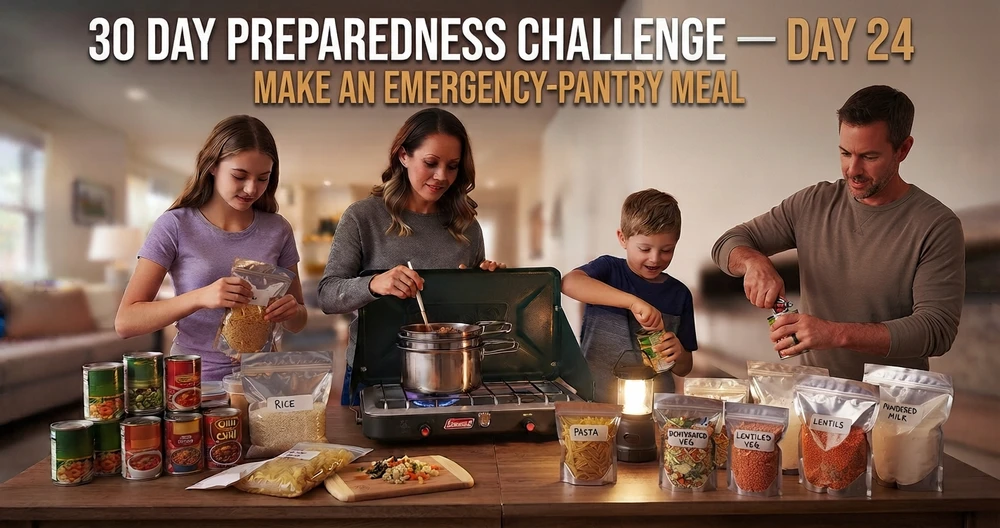
30 DAY PREPAREDNESS CHALLENGE — DAY 24 MAKE AN EMERGENCY-PANTRY MEAL
Posted by Mimi on Sep 24th 2026
30 DAY PREPAREDNESS CHALLENGE — DAY 24
MAKE AN EMERGENCY-PANTRY MEAL
TODAY WE'RE ACTUALLY GOING TO EAT THE EMERGENCY FOOD!
Welcome to Day 24!
We've spent a lot of time this month talking about food.
We've checked expiration and best-by dates.
We've planned no-cook meals.
We've found our manual can opener.
We've packaged food for long-term storage.
We've stored water.
But today we're going to find out something VERY important:
CAN WE ACTUALLY MAKE A MEAL FROM WHAT WE HAVE?
Because having 47 cans, six bags of rice and a beautiful shelf full of Mylar bags doesn't automatically mean we have dinner.
Today we're putting our preparedness pantry to the test.
TODAY'S CHALLENGE
Here's the rule:
DON'T GO SHOPPING FIRST.
Walk into your pantry, cupboards or food-storage area and make one meal using the foods you already have stored.
It doesn't have to be fancy.
It doesn't have to be a gourmet dinner.
And you don't have to pretend the apocalypse has arrived.
We're simply testing our food-storage plan.
MIMI'S RULE
I've said this over and over:
STORE WHAT YOU EAT.
EAT WHAT YOU STORE.
Today we're testing whether we've actually done that.
Choose foods your family normally eats or foods you've specifically stored for emergencies.
Then make dinner.
START IN THE PANTRY
Look around before deciding what you're making.
What do you already have?
Maybe:
- Canned chicken
- Tuna
- Beans
- Rice
- Pasta
- Potato flakes
- Oats
- Canned vegetables
- Canned or dried fruit
- Powdered milk
- Peanut butter
- Crackers
- Soup
- Seasonings
- Dehydrated vegetables
- Freeze-dried foods
Now ask:
“WHAT CAN I TURN INTO A COMPLETE MEAL?”
DON'T JUST STORE INGREDIENTS — STORE MEALS
This is one of my biggest food-storage lessons.
Sometimes we look at a pantry full of food and think:
“WE'RE SET!”
Then we actually try to make dinner and discover we have:
17 pounds of rice...
12 cans of green beans...
and absolutely nothing we want to put with them. ?
That's why I like thinking in MEALS instead of only ingredients.
For example:
MEAL IDEA #1
- Canned chicken
- Rice
- Canned or dehydrated vegetables
- Fruit
MEAL IDEA #2
- Pasta
- Jarred or canned sauce
- Shelf-stable protein if desired
- Vegetables
MEAL IDEA #3
- Beans
- Rice
- Corn
- Seasonings
MEAL IDEA #4 — NO COOKING
- Peanut butter
- Crackers
- Applesauce or fruit
- Nuts or trail mix
Nothing fancy.
Just food your family will actually eat.
DON'T FORGET THE FLAVOR!
Here's something that gets forgotten in emergency food storage:
SEASONINGS MATTER.
Rice and beans are wonderful storage foods.
But rice and beans over and over with absolutely no seasoning?
Your family may stage a pantry revolt.
Look at your:
- Salt
- Pepper
- Garlic
- Onion
- Taco seasoning
- Bouillon
- Herbs and spices
- Sauces and condiments
The little things that make ordinary food taste like your family's food can be very important.
Comfort matters too.
HOW MUCH WATER DID YOUR MEAL REQUIRE?
Remember Day 3 — Store Water?
Today gives us another reason why that mattered.
If your emergency meal includes:
- Rice
- Pasta
- Dehydrated potatoes
- Powdered milk
- Soup mixes
- Dehydrated foods
- Freeze-dried foods
...you may need water to prepare them.
So while you're making today's meal, notice:
HOW MUCH WATER DID I ACTUALLY USE?
Not just for drinking.
What about:
- Cooking?
- Rehydrating?
- Washing hands?
- Cleaning up afterward?
This is how our little daily preparedness lessons start connecting.
NOW ASK THE BIGGER QUESTION
Today you can use your normal kitchen.
But while you're cooking, ask:
“COULD I MAKE THIS IF THE POWER WAS OUT?”
Maybe the answer is YES.
Maybe it's NO.
Either answer teaches us something.
If your emergency food requires cooking, what is your safe backup cooking plan?
That might depend on your home, climate, equipment and emergency.
Whatever backup method you use, follow the manufacturer's instructions and use it only in a location where it is designed to be safely operated.
NEVER USE OUTDOOR-ONLY COOKING EQUIPMENT INDOORS.
And don't wait for an emergency to read the instructions for equipment you've never used.
REMEMBER DAY 20?
We found and tested our manual can opener.
Well...
Today is its moment to SHINE.
If today's meal uses canned food, try opening at least one can with your manual opener.
Does it work?
Is it comfortable to use?
Is it where you thought it was?
And here's something Broken-Wrist Mimi suddenly has a whole new appreciation for:
COULD SOMEONE ELSE IN YOUR HOUSE USE IT?
Because sometimes the person who normally cooks might not be able to.
Apparently preparedness enjoys giving pop quizzes.
LET THE FAMILY RATE THE MEAL
This part can actually be fun.
After dinner, ask everyone:
WOULD YOU EAT THIS DURING AN EMERGENCY?
You may get some VERY honest answers from the children.
Try a simple rating:
- YES — STORE MORE
- IT'S OKAY
- PLEASE NEVER SERVE THIS AGAIN
And listen to them!
There isn't much point in storing 48 cans of something nobody in your household will eat.
WHAT WAS MISSING?
This may be the most valuable part of today's challenge.
While preparing the meal, did you suddenly realize:
“Oh! I need...”
- Seasoning?
- Another ingredient?
- More stored water?
- A utensil?
- A backup cooking method?
- A working can opener?
- Disposable plates or bowls?
- Cleanup supplies?
Write it down.
THAT'S NOT FAILURE.
That's exactly why we're testing this NOW instead of discovering it during an emergency.
DON'T RUN OUT AND BUY EVERYTHING TONIGHT
You know Mimi's rule by now.
ONE LITTLE THING AT A TIME.
If today's meal revealed five gaps, add them to your normal shopping list.
Next grocery trip?
Pick up one.
Next month?
Add another.
Preparedness doesn't have to destroy the grocery budget.
Build slowly.
TRY THE “PANTRY MEAL” HABIT
Here's a preparedness habit I really like:
HAVE A PANTRY MEAL ONCE IN A WHILE.
Maybe once a month.
Choose dinner primarily from your stored foods.
That helps you:
✔️ Rotate food
✔️ Learn what your family likes
✔️ Practice using stored ingredients
✔️ Discover missing ingredients
✔️ Learn how much you really use
✔️ Prevent food from being forgotten
And most importantly...
YOUR FOOD STORAGE BECOMES PART OF YOUR NORMAL LIFE.
That's exactly what we want.
GET THE KIDS INVOLVED
Let the kids help choose the meal.
Ask:
“What can we make without going to the store?”
Have them look through the pantry.
Let them help gather ingredients.
Older children can help read instructions and prepare food with appropriate supervision.
Then let everybody vote on whether the meal earns a spot in your emergency-food rotation.
You might accidentally discover a new family favorite.
FOOD STORAGE ISN'T A MUSEUM
This is important.
Your food storage isn't something you're supposed to put on a shelf, admire for 17 years and never touch.
USE IT.
ROTATE IT.
REPLACE IT.
That's how you learn whether your plan actually works.
It's also how you keep your pantry familiar.
When an emergency happens, familiar foods and familiar meals can make a difficult situation feel a little more normal.
MIMI'S LITTLE FOOD-STORAGE FORMULA
When you're building your preparedness pantry, think:
FOOD + WATER + WAY TO PREPARE IT + WAY TO EAT IT = A MEAL.
Not just calories.
Not just cans.
Not just bags.
A MEAL.
Something you know how to prepare.
Something your family recognizes.
Something they'll actually eat.
TODAY'S CHALLENGE
Before you call Day 24 — DONE, try this:
☐ Go to your pantry WITHOUT shopping first
☐ Choose one meal from foods you already store
☐ Prepare it
☐ Notice how much water you use
☐ Use your manual can opener if appropriate
☐ Think about how you'd prepare it without electricity
☐ Check whether you have the seasonings you need
☐ Let your family taste-test it
☐ Write down anything that was missing
☐ Add needed items to your normal shopping list
☐ Decide whether this meal deserves a place in your emergency meal plan
BONUS:
Write down the meal somewhere you'll remember it.
You could even start a list called:
“MEALS WE CAN MAKE FROM OUR PANTRY”
The next time someone asks:
“WHAT'S FOR DINNER?”
you might actually be glad you did.
DAY 24 — DONE!
Today we didn't buy another emergency gadget.
We didn't add another tote.
We didn't make another giant preparedness list.
WE ATE DINNER.
But while doing it, we tested:
Our food storage.
Our water.
Our equipment.
Our cooking plan.
Our family's preferences.
And THAT is preparedness.
Don't just store emergency food.
LEARN HOW TO LIVE WITH IT.
Store what you eat.
Eat what you store.
Rotate what you use.
Replace what you need.
ONE LITTLE THING AT A TIME.
— Mimi
PackFreshUSA
TOMORROW — DAY 25 ?
If the power goes out...
If cell service is spotty...
If the internet isn't working...
WHERE WILL YOU GET RELIABLE EMERGENCY INFORMATION?
Tomorrow we're checking our emergency alerts and backup information sources.
Because knowing what is happening and what you're supposed to do can be just as important as having supplies.