
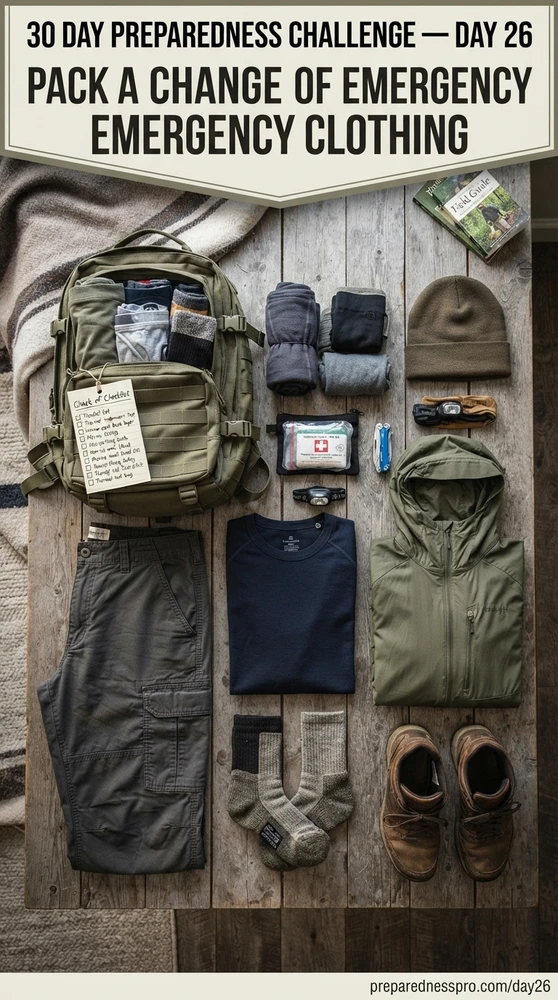
30 DAY PREPAREDNESS CHALLENGE — DAY 26 PACK A CHANGE OF EMERGENCY CLOTHING
Posted by Mimi on Sep 26th 2026
30 DAY PREPAREDNESS CHALLENGE — DAY 26
PACK A CHANGE OF EMERGENCY CLOTHING
BECAUSE THE CLOTHES YOU'RE WEARING MAY NOT BE THE CLOTHES YOU WANT TO STAY IN!
Welcome to Day 26!
We're getting close to the end of our 30 Day Preparedness Challenge!
Today we're going back to those Grab-N-Go Bags we've been building and checking throughout the month.
And we're adding something very ordinary:
CLOTHES.
It doesn't sound particularly exciting.
Until you're:
- Soaked from the rain
- Cold
- Sweaty and hot
- Covered in dirt or debris
- Dealing with a child who had an accident
- Injured
- Away from home longer than expected
Suddenly...
CLEAN, DRY SOCKS CAN FEEL LIKE A LUXURY.
TODAY'S CHALLENGE
Put one practical change of clothing into each person's Grab-N-Go Bag.
Or, if clothing is already packed:
TAKE IT OUT AND CHECK IT.
Because I'm willing to bet there is a family somewhere with a 12-year-old carrying size 7 emergency underwear.
Kids grow.
Seasons change.
Bodies change.
Needs change.
Emergency bags need to change with us.
START WITH THE BASICS
You don't need an entire suitcase.
Remember our Day 15 rule:
SMALL. LIGHT. USEFUL.
Start with:
- Shirt
- Pants or practical bottoms
- Underwear
- Socks
That's your basic change of clothes.
Depending on your situation, you may also want:
- Lightweight jacket or sweatshirt
- Gloves
- Hat
- Sun protection
- Rain protection
- Cold-weather layers
Build for your climate, your family and your needs.
MIMI VOTES FOR EXTRA SOCKS
If I had to choose one clothing item to have an extra pair of...
SOCKS.
Wet feet are miserable.
Cold feet are miserable.
Dirty socks are miserable.
And if you're walking farther than expected, taking care of your feet becomes even more important.
An extra pair of clean, dry socks takes up very little room.
If you have space, I wouldn't mind having two pairs.
WHAT ABOUT SHOES?
Remember Day 1?
We put sturdy, easy slip-on shoes near the bed.
Now think about your Grab-N-Go Bag.
You probably don't want to stuff a giant pair of boots into every emergency bag.
But ask:
“IF I HAD TO LEAVE RIGHT NOW, WHAT WOULD BE ON MY FEET?”
Flip-flops?
Slippers?
Bare feet?
Your fuzzy purple house shoes?
That's why those sturdy shoes near the bed matter.
Depending on your situation, you may also decide that keeping an extra practical pair of shoes with your emergency supplies makes sense.
Just remember:
SHOES NEED TO FIT TOO.
Especially children's shoes.
KIDS GROW!
This might be today's biggest assignment for parents and grandparents.
CHECK THE SIZE.
Take those emergency clothes out.
Hold them up.
Look at the tag.
Better yet, if you're unsure...
HAVE THE CHILD TRY THEM ON.
That adorable little emergency outfit you packed two years ago may now fit the younger sibling. ?
Check:
- Shirts
- Pants
- Underwear
- Socks
- Shoes
- Jackets
If they've outgrown something, replace it.
And don't throw the good clothing away.
Move it to the next child, donate it, or put it back into normal use.
ADD CLOTHING TO YOUR SIX-MONTH CHECK
We've talked several times this month about checking emergency supplies every six months.
This belongs on that list too.
When you check:
- Batteries
- Emergency snacks
- Backup power
- Pet supplies
- First-aid supplies
...check the emergency clothes.
SPRING AND FALL ARE GREAT TIMES.
Does everything still fit?
Is it appropriate for the coming season?
Is anything damaged?
Do you need warmer or lighter clothing?
That simple routine keeps your bags useful.
THINK ABOUT YOUR SEASON
Emergency clothing in July may look very different from emergency clothing in January.
Ask yourself:
“WHAT WEATHER ARE WE MOST LIKELY TO FACE DURING THE NEXT SIX MONTHS?”
Cold climate?
Think layers.
Hot climate?
Think lightweight, breathable clothing and sun protection.
Rainy season?
Consider appropriate rain protection.
Snow?
Warm layers become much more important.
You don't need to prepare for every climate on Earth.
PREPARE FOR WHERE YOU ACTUALLY LIVE.
THINK IN LAYERS
Layers can give you more flexibility than one giant bulky item.
Depending on your climate:
- Base shirt
- Long-sleeve layer
- Sweatshirt or jacket
- Weather protection
You can add or remove layers as conditions change.
And remember:
We're trying to build a Grab-N-Go Bag...
NOT PACK FOR A THREE-WEEK CRUISE.
BABIES AND LITTLE ONES NEED MORE
If you have babies or toddlers, one outfit might not be enough.
Parents already know why.
Consider:
- Extra clothing
- Socks
- Bibs
- Diapers
- Wipes
- Weather-appropriate layers
And check these supplies frequently.
Babies have an incredible ability to outgrow something approximately five minutes after you buy it.
WHAT IF SOMEONE IS INJURED?
Well...
Broken-Wrist Mimi has entered the lesson again. ?
I've learned very quickly that clothing that is easy with two working hands can become considerably more interesting when you suddenly have ONE.
So here's another preparedness question I hadn't thought much about before:
“COULD I MANAGE THESE CLOTHES IF I WERE INJURED?”
Things like:
Easy closures.
Stretchy waistbands.
Loose-fitting shirts.
Slip-on shoes.
Clothing that's simple to layer.
Those things can become surprisingly helpful.
You don't need to redesign your entire emergency wardrobe.
Just remember:
EMERGENCIES DON'T ALWAYS HAPPEN WHEN WE'RE HEALTHY AND AT OUR STRONGEST.
Preparedness should work for real people in real situations.
We're going to talk much more about that on Day 29. ?
PERSONALIZE THE BAG
Just like everything else we've done this month, your emergency clothing should fit the person.
Think about:
- Babies
- Children
- Older adults
- Mobility or accessibility needs
- Temporary injuries
- Medical needs
- Sensitivity to heat or cold
There is no perfect emergency clothing list for every person.
The best emergency clothing is:
CLOTHING THAT FITS THE PERSON WHO ACTUALLY HAS TO WEAR IT.
YOU DON'T HAVE TO BUY NEW CLOTHES
Please don't think today's challenge means everyone needs a brand-new emergency wardrobe.
Shop your own closets first!
That comfortable T-shirt?
Perfect.
Older sweatpants that still fit?
Great.
Extra socks?
In they go.
Sweatshirt?
Done.
Emergency clothing doesn't have to be fashionable.
Although Mimi would argue that a little purple never hurts. ??
It needs to be:
CLEAN.
PRACTICAL.
COMFORTABLE.
THE RIGHT SIZE.
KEEP CLOTHING DRY
Your beautiful emergency outfit won't be nearly as useful if it gets wet before you ever need it.
Consider keeping your emergency clothing together inside a protective bag or pouch within your Grab-N-Go Bag.
You can even separate clothing by person and label it:
MOM
DAD
ISABELLA
BABY
Whatever makes sense for your family.
Compressing soft clothing can also help save space—but make sure you can still easily get to what you need.
MAKE THIS A FAMILY CHALLENGE
Everybody gets their Grab-N-Go Bag.
Everybody pulls out their emergency clothes.
And then ask:
“DOES THIS STILL FIT YOU?”
This could get entertaining. ?
Have children help choose their replacement clothing.
They may be much happier wearing something they picked themselves.
And while everything is out...
Check the bag again.
Anything too heavy?
Anything missing?
Anything they've outgrown?
Anything that doesn't belong anymore?
You're already there.
Might as well look.
TODAY'S 10-MINUTE CHALLENGE
Before you call Day 26 — DONE, check:
☐ One change of practical clothing per person
☐ Underwear
☐ Socks — preferably an extra pair if space allows
☐ Weather-appropriate layer
☐ Clothing still fits
☐ Children's clothing sizes checked
☐ Children's shoes checked if packed
☐ Clothing appropriate for the current/coming season
☐ Baby/toddler clothing and supplies checked
☐ Accessibility or injury needs considered
☐ Clothes protected from moisture
☐ Bags aren't becoming unnecessarily heavy
☐ Add clothing to your six-month emergency-supply check
BONUS:
Ask everyone:
“IF WE HAD TO LEAVE HOME RIGHT NOW, ARE YOU WEARING SHOES YOU COULD WALK IN?”
Remember Day 1!
DAY 26 — DONE!
Today wasn't about buying tactical pants or some fancy emergency outfit. ?
It was about something much simpler.
CLEAN.
DRY.
COMFORTABLE.
PRACTICAL.
FITS.
That's it.
Because if you're away from home, wet, dirty, cold, hot, tired or injured...
a clean shirt and a dry pair of socks can feel pretty wonderful.
And if you discovered your teenager's emergency pants haven't fit since elementary school...
Well...
THAT'S WHY WE CHECK.
Preparedness changes as our families change.
Keep checking.
Keep adjusting.
Keep going.
ONE LITTLE THING AT A TIME.
— Mimi
PackFreshUSA
TOMORROW — DAY 27
We've talked about emergency toilets.
We've talked about personal hygiene.
Tomorrow we're checking something we use every day but may not think of as emergency supplies:
HOUSEHOLD SANITATION SUPPLIES.
Soap.
Trash bags.
Gloves.
Toilet paper.
Cleaning supplies.
Wipes.
We're going to find out whether we actually have enough of the everyday basics to get through a disruption without making an emergency even messier!