
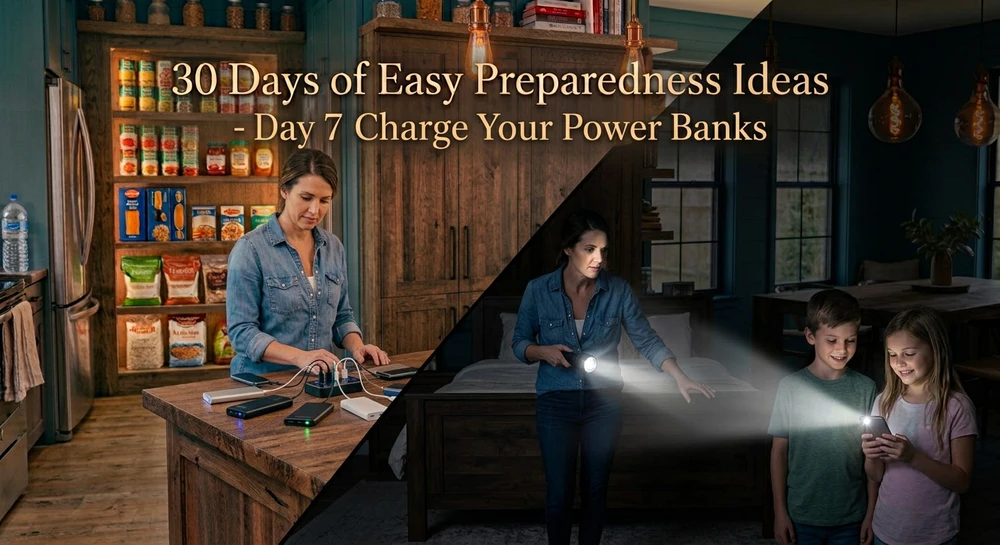
30 Easy Preparedness Ideas - Day 7 - Charge Your Backup Power
Posted by Mimi on Sep 7th 2026
30 Easy Preparedness Ideas — Day 7
Charge Your Backup Power
Welcome to Day 7 of 30 Easy Preparedness Ideas for National Preparedness Month!
Today's challenge might be one of our easiest yet:
Find your backup power devices and CHARGE THEM!
We have power banks, rechargeable flashlights, lanterns and other gadgets tucked into drawers, backpacks and closets.
But here's the question:
Are they actually charged?
A power bank with a dead battery isn't going to be much help when the electricity goes out!
Today we're going to find them, charge them, test them and put them somewhere we can easily find them.
Start With Your Power Banks
If you have portable power banks for your phones or tablets, pull them out today.
Plug them in and give them a full charge according to the manufacturer's instructions.
Then make sure you have the right charging cables stored with them.
Mimi's Tip: Having a fully charged power bank isn't very helpful if you can't find the cable that connects it to your phone!
If your household has different types of phones or devices, check that you have the cables everyone needs.
Check Your Rechargeable Flashlights
Remember Day 1, 30 Days of Easy Preparedness - Day 1: Shoes & Flashlights at the Bedside - PackFreshUSA, when we put easy slip-on shoes and a flashlight next to our beds?
Let's check that flashlight again!
If it's rechargeable, plug it in.
Then look around your house for other rechargeable lights:
- Flashlights
- Lanterns
- Emergency lights
- Headlamps
- Rechargeable work lights
Turn each one on and make sure it actually works.
Don't discover your rechargeable flashlight has been sitting dead in a drawer when the lights suddenly go out.
Don't Underestimate a Good Lantern
Flashlights are wonderful when you're moving around, but lanterns can be incredibly useful during a longer power outage.
A lantern can provide light for an entire area while your hands remain free.
Think about where your family would gather during a power outage.
Would you have enough light to:
- Prepare or eat a meal?
- Play a game?
- Read?
- Handle a minor first-aid need?
- Take care of children?
- Take care of pets?
You don't need to light your entire house.
Sometimes one or two strategically placed lights can make a huge difference.
Your Phone Is an Emergency Tool
During an emergency, your phone may become one of your most valuable tools.
You may use it to:
- Contact family
- Receive emergency alerts
- Check evacuation information
- Follow weather information
- Navigate
- Send messages
- Use the flashlight
That means preserving your phone's battery matters.
A charged backup power bank gives you another option when the electricity isn't available.
Mimi's Tip: During an outage, conserve your phone battery. Lower the screen brightness and avoid unnecessary apps, videos and other heavy battery use.
Put Some Backup Power in Your Grab-N-Go Bag
We've been working on our Grab-N-Go Bags throughout this challenge.
Today is a great time to add:
- A charged power bank
- The correct charging cable
- A small flashlight or headlamp
You may want to keep one power bank with your household emergency supplies and another in your Grab-N-Go Bag.
Just remember:
Anything rechargeable needs to be checked periodically.
Add Backup Power to Your 6-Month Check
Yesterday we talked about checking and rotating the snacks in our Grab-N-Go Bags every six months.
Let's add one more thing to that routine.
BATTERIES, SNACKS & POWER DAY!
Every six months:
- Check household batteries
- Rotate Grab-N-Go snacks
- Test flashlights and lanterns
- Recharge power banks
- Check charging cables
- Check the rest of your Grab-N-Go supplies
One little reminder can take care of several preparedness jobs at once.
Of course, follow the manufacturer's recommendations for charging and storing your particular devices, and check rechargeable equipment more often if needed.
Check the Condition Too
While you're charging everything, take a quick look at the devices and batteries.
If you notice a rechargeable battery or power bank that is swollen, leaking, unusually hot, cracked or damaged, stop using it and follow appropriate manufacturer/local guidance for safe handling and disposal.
Don't toss damaged rechargeable batteries into your regular household trash.
Preparedness includes keeping our emergency equipment safe too.
Mimi's Challenge: Can You Find It in the Dark?
Here's a fun little test.
Tonight, stand in your bedroom or main living area and ask yourself:
“If the power went out RIGHT NOW, could I find my flashlight without using my phone?”
That's why Day 1 was so important!
Your flashlight shouldn't be buried in the junk drawer underneath 14 mystery charging cords and batteries you're not sure are good.
Give your emergency lights a home.
Make sure everyone in the household knows where that is.
Mimi's Bonus Tip: Don't Forget Your Solar Garden Lights!
Here's an emergency light you may already own—and it might be sitting right outside your front door!
Solar garden lights can provide a little extra light during a power outage.
Most spend the day outside charging from sunlight. If the power goes out at night and your solar lights are charged and working, you may be able to bring them inside temporarily to provide some extra light.
Place them in areas where a little illumination could help, such as:
- Near a doorway
- Along a hallway
- Near the bathroom
- In your main gathering area
- Near a stairway or other area where visibility is important
They can also help preserve your flashlight batteries for situations when you really need brighter or portable light.
Mimi's Tip: Test your solar garden lights as part of today's challenge. Make sure the solar panels are clean and place the lights where they can receive adequate sunlight to charge.
If you're expecting severe weather that could cause an outage, charging your solar lights outside during the day gives you another potential source of light that evening.
Think in Layers
I like having more than one way to light the house during an emergency:
- Flashlight — for moving around
- Lantern — for lighting a room or gathering area
- Headlamp — for hands-free tasks
- Solar garden light — supplemental lighting
- Power bank — keeps phones and other small devices going
You don't necessarily need to run out and buy everything.
Look around your house first. You may already have another emergency tool sitting in your garden!
Just remember that solar garden lights vary greatly in brightness and how long they hold a charge, so consider them a backup or supplemental light source, not your only emergency lighting plan.
TODAY'S EASY PREPAREDNESS CHALLENGE
Take 10 minutes today:
☐ Find your power banks
☐ Charge them
☐ Find the correct charging cables
☐ Charge rechargeable flashlights
☐ Charge lanterns and headlamps
☐ Test your emergency lights
☐ Add backup power to your Grab-N-Go Bag
☐ Check devices for damage
☐ Decide where your emergency lights will live
☐ Make sure everyone knows where they are
✅ DAY 7 — DONE!
No giant emergency purchase today.
No complicated project.
We simply took the emergency equipment we already own and made sure it will actually work when we need it.
Find it.
Charge it.
Test it.
Put it where you can find it.
That's another easy preparedness job checked off our list!
See you tomorrow for Day 8!
— Mimi
One little step at a time.
PackFreshUSA | 30 Easy Preparedness Ideas