
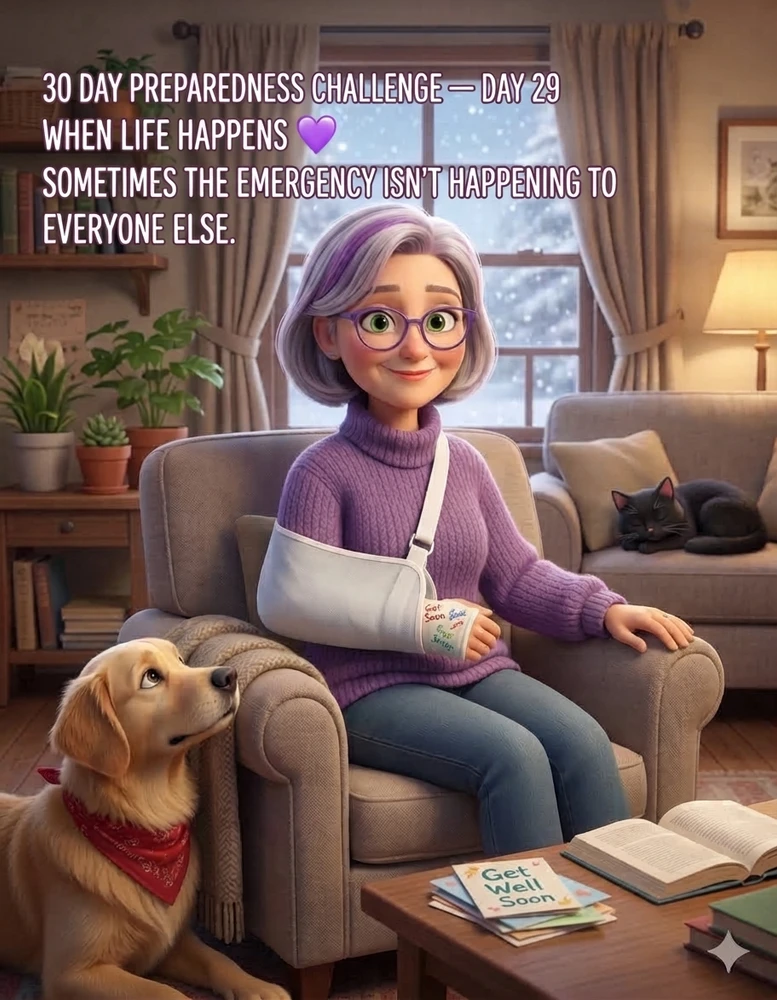
30 DAY PREPAREDNESS CHALLENGE — DAY 29 WHEN LIFE HAPPENS (SOMETIMES THE EMERGENCY ISN'T HAPPENING TO EVERYONE ELSE.)
Posted by Mimi on Sep 29th 2026
30 DAY PREPAREDNESS CHALLENGE — DAY 29
WHEN LIFE HAPPENS ?
SOMETIMES THE EMERGENCY ISN'T HAPPENING TO EVERYONE ELSE.
Welcome to Day 29.
We're almost there.
For the last 28 days, we've talked about preparing for all kinds of emergencies.
Power outages.
Evacuations.
Water disruptions.
Fires.
Sanitation problems.
Communication outages.
And then...
I BROKE MY WRIST.
Well...
THAT WASN'T ON MY 30 DAY PREPAREDNESS CHALLENGE.
There wasn't a weather warning.
There wasn't an evacuation notice.
There wasn't an emergency alert on my phone.
The power didn't go out.
The water was still running.
The grocery store was open.
Life simply happened.
And it reminded me of something I've believed about preparedness for a very long time:
NOT EVERY EMERGENCY IS A DISASTER.
Sometimes the emergency is personal.
WHAT IF IT HAPPENED TOMORROW?
Think about your household for a minute.
What if the main breadwinner broke an arm or a leg tomorrow?
What if someone needed surgery?
What if a vehicle suddenly needed an expensive repair?
What if work hours were unexpectedly cut?
What if someone had to stay home to care for a child or family member?
What if an unexpected expense landed in your lap?
Nothing happened to the rest of the town.
The grocery store is still open.
The lights are still on.
But suddenly...
YOUR FAMILY IS HAVING AN EMERGENCY.
That's preparedness too.
SOMETIMES FOOD STORAGE IS THE EMERGENCY FUND YOU CAN EAT
This is one of the reasons I'm so passionate about food storage.
When money suddenly gets tight, having food in the pantry means there are groceries you don't have to buy this week.
That bag of rice.
Those beans.
The canned chicken.
The pasta.
The vegetables.
The flour.
The food you've packaged for longer-term storage.
The meals you've already planned.
Suddenly they're doing exactly what you stored them to do:
HELPING YOUR FAMILY.
Food storage isn't only for earthquakes, hurricanes or power outages.
Sometimes it's there because the paycheck is smaller than expected.
Sometimes it's there because the money needs to go toward something else.
Sometimes...
THE PANTRY IS WHAT GIVES YOUR BUDGET A LITTLE BREATHING ROOM.
REMEMBER DAY 24?
We made a meal using foods we already had stored.
That wasn't just an emergency cooking exercise.
It was practice for THIS too.
If money were suddenly tight...
HOW MANY MEALS COULD YOU MAKE WITHOUT GOING TO THE STORE?
One?
Three?
A week?
Don't worry about what the answer “should” be.
Just know your answer.
Then slowly work toward making it a little better.
AND THEN THERE'S EMERGENCY SAVINGS
Remember Day 12?
We started a small emergency cash stash.
I told you it didn't have to be hundreds of dollars.
Start with:
$5.
$10.
$20.
Because little amounts eventually become bigger amounts.
And today's lesson is exactly why.
Emergency savings may help cover:
- Gas
- Prescriptions
- Medical copays
- Transportation
- Bills
- Groceries
- Household needs
It doesn't have to solve every problem.
Sometimes having enough to solve ONE problem is a tremendous help.
START WITH $5 AND ONE EXTRA MEAL
I don't want anyone reading this and thinking:
“Well, I don't have six months of expenses saved, so I guess I'm not prepared.”
No.
That's not what this challenge has been about.
Remember?
ONE LITTLE THING AT A TIME.
Can you save $5?
Start there.
Can you put together one extra pantry meal?
Start there.
Can you slowly build enough food for a few days?
Start there.
Can you add another $5 next week?
Wonderful.
Preparedness doesn't have to begin with a giant bank account and a room full of food.
It begins with deciding:
“I WANT TO GIVE MY FAMILY A LITTLE CUSHION.”
THE ONE-HANDED PREPAREDNESS TEST
Now let's talk about something Broken-Wrist Mimi has learned firsthand.
There are a LOT of things that are surprisingly difficult with one hand.
So here's today's practical challenge.
Look at some of your emergency supplies and ask:
“COULD I USE THIS IF I WERE INJURED?”
Can you:
- Open your emergency food?
- Lift your stored water?
- Carry your emergency bag?
- Open medication containers?
- Prepare a simple meal?
- Reach and operate your flashlight?
- Open the doors you need to use?
- Get dressed?
- Manage your pet?
And maybe YOU could.
But what about someone else in your household?
THE PERSON WHO “DOES EVERYTHING”
Most households have one.
The person who knows:
Where the important papers are.
Where the medication is.
Which bag belongs to whom.
How the emergency food is prepared.
Where the pet carrier is.
How the equipment works.
Where the spare keys are.
How to shut off the water.
What everybody is supposed to grab.
Sometimes...
WE ACCIDENTALLY MAKE ONE PERSON THE ENTIRE EMERGENCY PLAN.
What happens if that person is the one who's injured?
Or isn't home?
That's something worth thinking about.
TEACH SOMEONE ELSE
Today's preparedness project might be as simple as teaching another person ONE thing you normally handle.
Show someone:
- Where the emergency supplies are.
- Where the water shutoff is.
- Which Grab-N-Go Bag belongs to whom.
- Where the pet supplies are.
- How to prepare one stored meal.
- Where your emergency information is kept.
- Where the flashlights are.
- Where appropriate backup keys are stored.
You don't need everyone to know everything today.
Just make sure you aren't the only person who knows everything.
PREPAREDNESS SHOULD WORK FOR REAL PEOPLE
This is something I think we sometimes forget.
Preparedness plans aren't being used by perfectly healthy people standing calmly in a perfectly organized room.
They're being used by...
Someone who's scared.
Someone who's tired.
Someone carrying a baby.
Someone helping an older parent.
Someone with limited mobility.
Someone who can't see without their glasses.
Someone with an injury.
Someone with only one good hand.
A child.
A grandparent.
A person having a REALLY bad day.
BUILD YOUR PLAN FOR REAL LIFE.
Not for the imaginary perfect version of your family.
MAKE THINGS EASIER TO USE
Today's a good day to look at your supplies from an accessibility point of view.
Could something be:
✔️ Stored lower?
✔️ Made lighter?
✔️ Divided into smaller containers?
✔️ Labeled more clearly?
✔️ Moved somewhere easier to reach?
✔️ Opened without complicated tools?
✔️ Used by another family member?
✔️ Organized so someone else can find it?
Remember our Grab-N-Go Bag rule:
SMALL. LIGHT. USEFUL.
Maybe that rule applies to more than just bags.
PREPAREDNESS CAN BUY YOU TIME
This may be my favorite way to think about preparedness.
PREPAREDNESS BUYS TIME.
Stored food may buy you time before you need groceries.
Stored water may buy you time during an interruption.
Emergency savings may buy you time while you figure out finances.
A stocked household may buy you time before you need to shop.
A family plan may buy you time when decisions need to happen quickly.
Knowing what to do may buy you time when everyone else is trying to figure it out.
Preparedness doesn't guarantee that hard things won't happen.
They will.
But sometimes it gives you a little room to say:
“OKAY. WE CAN HANDLE TODAY.”
And tomorrow...
we handle tomorrow.
YOU DON'T HAVE TO PREPARE FOR EVERYTHING
You can't.
None of us can.
I certainly didn't wake up this month and think:
“You know what would really improve this preparedness series? A BROKEN WRIST.”
But that's exactly the point.
We don't know what's coming.
Preparedness isn't predicting every possible emergency.
It's building enough flexibility into our lives that when something unexpected happens...
WE HAVE OPTIONS.
Maybe there's food.
Maybe there's savings.
Maybe there's water.
Maybe someone else knows how to do the job.
Maybe the emergency bag is ready.
Maybe the family already has a plan.
Maybe we aren't starting from zero.
And that matters.
TODAY'S CHALLENGE
Day 29 is a little different.
Today I want you to ask:
“WHAT WOULD HELP MY FAMILY IF LIFE GOT HARD TOMORROW?”
Then choose ONE thing.
Maybe:
☐ Put $5 into emergency savings
☐ Plan one extra pantry meal
☐ Add one food your family regularly eats to storage
☐ Teach someone else where emergency supplies are
☐ Show another adult how to prepare one stored meal
☐ Make one emergency item easier to access
☐ Lighten something that's too heavy
☐ Check whether supplies could be used with an injury
☐ Make sure another family member understands an important household task
☐ Write down information that currently exists only in your head
Just one.
That's enough.
DAY 29 — DONE
Today wasn't about hurricanes.
It wasn't about earthquakes.
It wasn't about wildfires.
It wasn't about the power grid.
It was about something much closer to home.
LIFE.
People get hurt.
Cars break.
Jobs change.
Bills arrive.
Children get sick.
Plans fall apart.
Unexpected things happen.
And sometimes the preparations we made for “an emergency” become the very things that help us through an ordinary difficult week.
That pantry full of food?
It matters.
That little emergency fund?
It matters.
That family member who knows where everything is?
It matters.
That extra household supply you bought?
It matters.
That plan you've practiced?
It matters.
Because:
PREPAREDNESS ISN'T ONLY FOR THE END OF THE WORLD.
SOMETIMES IT'S FOR GETTING THROUGH NEXT WEEK. ?
And if all you can do today is put away $5...
or store one extra meal...
or teach one person one thing...
You've prepared.
ONE LITTLE THING AT A TIME.
— Mimi
PackFreshUSA
TOMORROW — DAY 30
Thirty days.
Thirty little things.
And tomorrow...
WE'RE PUTTING IT ALL TOGETHER.
We're going to review what we've done, restock what we've used, fix the gaps we've discovered and decide how we're going to keep going.
And there's one more question I want us to ask before this challenge ends:
“WHO OUTSIDE MY HOUSEHOLD MIGHT NEED A LITTLE HELP?”
A neighbor.
An older relative.
A friend who lives alone.
Someone with a disability.
A new parent.
Because preparedness isn't only about what we have stored.
Sometimes...