
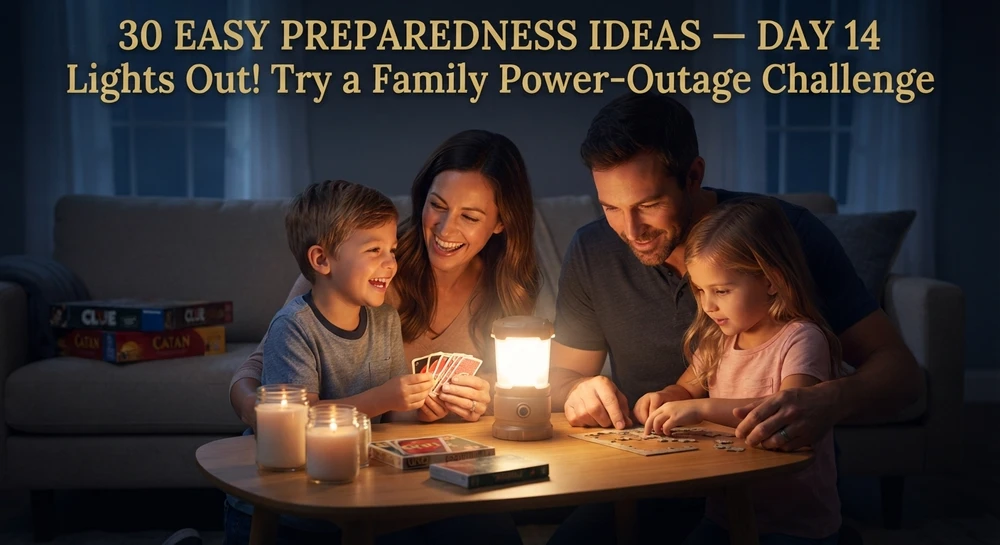
30 EASY PREPAREDNESS IDEAS - DAY 14 - Lights Out! Try a Family Power-Outage Challenge
Posted by Mimi on Sep 14th 2026
30 EASY PREPAREDNESS IDEAS — DAY 14
Lights Out! Try a Family Power-Outage Challenge
Welcome to Day 14 of our 30 Easy Preparedness Ideas!
Today's challenge is going to be a little different.
And if you have kids or grandkids at home...
LET'S MAKE THIS ONE FUN!
Tonight, we're going to pretend the power went out.
Not all night.
Not even for an hour.
We're talking about a simple:
15–30 MINUTE FAMILY POWER-OUTAGE CHALLENGE!
Turn off the lights and see what happens.
Can everyone find a flashlight?
Do the flashlights actually work?
Can the kids safely move around the house?
Where's the lantern?
Where's the backup power?
And...
Does everyone know what to do if this were REAL?
That's what we're finding out today.
READY...SET...LIGHTS OUT!
Pick a time when the family is home and explain what you're doing first.
This shouldn't be scary—especially for little ones.
Tell them:
“We're going to pretend the power went out so we can practice what to do.”
Then turn off the lights.
Now ask:
“WHERE'S THE FLASHLIGHT?”
Let the kids show you!
Remember Day 1?
We put sturdy slip-on shoes and a flashlight near the bed.
And on Day 7, we charged our backup power, flashlights and emergency lighting.
Today we get to see if our plan actually works.
CAN THE LITTLE ONES FIND A LIGHT?
One of today's most important lessons is very simple:
Every child should know where the family keeps emergency lights, as appropriate for their age.
If the lights suddenly go out at night, little ones can become frightened.
Having a familiar plan can help.
Show them:
- Where the flashlights are
- Where the lanterns are
- Which emergency lights they may use
- Where their shoes are
- Where the family should gather
Then practice.
You can even make it a game:
THE FLASHLIGHT CHALLENGE!
“Okay! The power just went out. Show Mimi where the flashlight is!”
No running through the dark!
No climbing on furniture!
No digging through scary closets!
The goal is for emergency lighting to be easy and safe to reach.
Mimi's Tip: If the flashlight is so well hidden that nobody can find it during a pretend outage...
You just discovered something you can fix BEFORE a real one!
That's exactly why we practice.
LET'S TALK ABOUT 911
While everyone is together, today's challenge gives us a great opportunity to teach little ones another important skill:
HOW AND WHEN TO CALL 911.
Children who are developmentally ready should understand that 911 is for real emergencies when someone needs immediate help from police, firefighters or an ambulance.
Explain it in simple terms.
For example:
- There's a fire.
- Someone is badly hurt or very sick and needs immediate help.
- There is serious danger and an adult cannot call for help.
Also teach them:
911 IS NOT A GAME.
We don't call 911 because the lights went out.
We don't call to practice.
We don't call because we're bored or curious.
We call when there is a real emergency and we need immediate help.
WHAT SHOULD A CHILD KNOW?
Keep this age appropriate.
A young child doesn't need a complicated emergency lecture.
Start with the basics.
Help them learn:
- Their first and last name
- Parent or guardian names
- Their home address, when they're able to learn it
- How to call 911 on the phones/devices available in your home
- How to tell the dispatcher what happened
- How to listen carefully and answer questions
- How to say where they are if they know
- When and how to get to a safe adult or safe location
One of the most important lessons:
STAY ON THE LINE AND LISTEN TO THE 911 DISPATCHER.
Teach children that the dispatcher is there to help them.
They should answer questions as best they can and follow the dispatcher's instructions.
BUT OUR PHONES ARE LOCKED!
Here's something worth checking during today's challenge.
Does your child know how to access the emergency-call function on the phones they may need to use?
Phones and devices can work differently.
Don't assume a child knows how simply because they've watched you use your phone.
Show them.
You can demonstrate how to reach the emergency-call screen without actually placing a 911 call.
If your household still has another way to make emergency calls, make sure family members know where and how to use it too.
REMEMBER DAY 13?
Yesterday we made our Emergency Contact Cards!
Perfect timing.
During tonight's challenge, ask the kids:
“Where is your Emergency Contact Card?”
Do they know?
Remember, 911 is for emergencies requiring immediate help.
For other situations, their Emergency Contact Card contains the trusted people they can contact.
This is how our little daily preparedness jobs begin working together!
MAKE TONIGHT A FAMILY GAME
Preparedness doesn't have to feel frightening.
Try turning the power-outage drill into a family challenge.
CHALLENGE #1 — FIND THE LIGHT
Who knows where the flashlight is?
CHALLENGE #2 — FIND YOUR SHOES
Can everyone find sturdy shoes without wandering through the dark barefoot?
CHALLENGE #3 — LIGHT THE ROOM
Can you safely light your main gathering area using your emergency lanterns or other backup lighting?
Remember our solar garden lights from Day 7?
If they're charged and suitable for bringing inside temporarily, try one as supplemental lighting.
CHALLENGE #4 — FIND THE POWER
Where's the charged power bank?
Does it have the correct phone cable?
CHALLENGE #5 — WHAT WOULD YOU DO?
Ask age-appropriate questions:
“The lights went out. Do we call 911?”
No—not just because the power is out.
“What if you see a fire?”
Get to safety and alert an adult; call 911 when appropriate.
“What if someone is badly hurt and the grown-up can't call for help?”
That's when knowing how to call 911 can matter.
AND THEN...HAVE A LITTLE FUN!
Once everyone has passed the challenge...
Why not keep the lights off for a few more minutes?
Grab some of those emergency snacks we packed on Day 6.
Sit around the lantern.
Tell stories.
Play a simple game.
Talk.
Let the kids use their flashlights.
You might discover something wonderful:
Preparedness practice can become a family memory.
And the next time the lights really do go out?
Instead of immediately thinking:
“THIS IS SCARY!”
A child may remember:
“We practiced this. I know where my flashlight is.”
That's a win.
DON'T FORGET THE PETS
How did your pets do with the lights off?
Could you find:
- Their leash?
- Their carrier?
- Enough light to safely locate them?
- Their Pet Grab-N-Go Bag?
A frightened pet may behave differently during an outage or emergency, so knowing where their supplies are matters too.
WHAT DID YOU DISCOVER?
At the end of your 15–30 minutes, ask everyone:
“What did we need that we couldn't find?”
Maybe:
- Someone needs their own flashlight.
- A flashlight needs batteries.
- The lantern wasn't where you thought it was.
- Nobody knew where the power bank was.
- You had 14 charging cables—and none fit the phone.
- Someone's emergency shoes don't fit anymore.
- A child didn't know the home address.
- Someone didn't know how to access the phone's emergency-call function.
Wonderful!
THAT IS THE PURPOSE OF A DRILL.
We aren't trying to prove we're perfectly prepared.
We're trying to discover what needs fixing.
MIMI'S TIP: PRACTICE WITHOUT FEAR
Children learn through repetition.
Preparedness doesn't have to mean frightening them with everything that could go wrong.
Instead, teach:
“This is what our family does.”
The lights go out?
We know where the flashlights are.
We need help?
We know which grown-up to find.
There's a real emergency?
We know how to call 911.
We get separated?
We have our Emergency Contact Card.
Simple.
Calm.
Practiced.
TODAY'S EASY PREPAREDNESS CHALLENGE
Tonight:
☐ Turn off the lights for 15–30 minutes
☐ Have everyone locate emergency lighting
☐ Check that flashlights actually work
☐ Find your lanterns
☐ Find your backup power
☐ Make sure charging cables fit
☐ Show children where emergency lights are kept
☐ Review age-appropriate 911 basics
☐ Help children learn their name and address as appropriate
☐ Review yesterday's Emergency Contact Card
☐ Ask the family what was difficult to find
☐ Write down anything you need to fix
Then...
HAVE A SNACK AND ENJOY THE LIGHTS-OUT ADVENTURE!
✅ DAY 14 — DONE!
Tonight we didn't just check another box.
WE PRACTICED.
And there's a big difference between owning emergency supplies and knowing how to use them.
Your kids know where the flashlights are.
Your family knows where to gather.
Your little ones are beginning to understand when and how to get help.
And you discovered what still needs work.
That's preparedness.
PRACTICE IT BEFORE YOU NEED IT.
Tomorrow is Day 15, and we're going to pull a LOT of what we've done over the last two weeks together:
CAN YOU GRAB YOUR GRAB-N-GO BAG AND ACTUALLY GO?
Until then...
One little thing at a time.
— Mimi
PackFreshUSA | 30 Easy Preparedness Ideas