
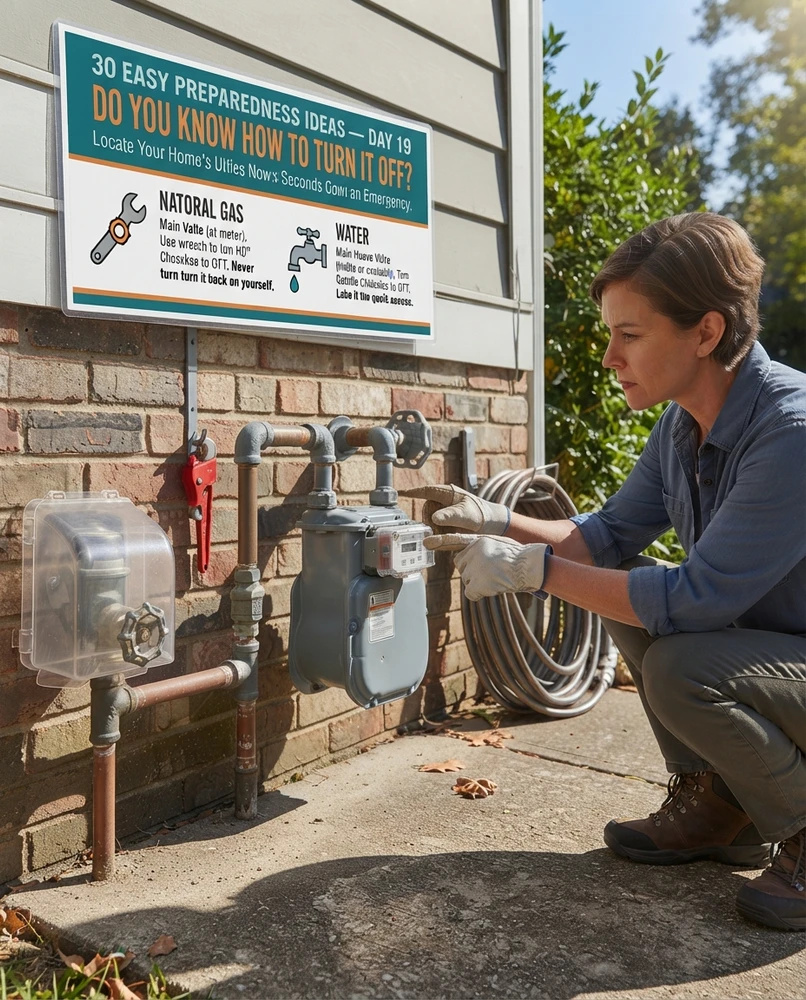
30 EASY PREPAREDNESS IDEAS — DAY 19 DO YOU KNOW HOW TO TURN IT OFF?
Posted by Mimi on Sep 19th 2026
30 EASY PREPAREDNESS IDEAS — DAY 19
DO YOU KNOW HOW TO TURN IT OFF?
Welcome to Day 19 of our 30 Easy Preparedness Ideas!
Over the last couple of days, we've been working on our family emergency plan.
Day 17: How do we get out?
Day 18: Where do we meet?
Today we're staying close to home and answering another really important question:
DO YOU KNOW WHERE YOUR UTILITY SHUTOFFS ARE?
We're talking about:
- WATER
- NATURAL GAS — if your home has it
- ELECTRICITY
Here's the good news:
TODAY WE ARE NOT SHUTTING EVERYTHING OFF!
Today's challenge is about:
FIND IT.
LEARN IT.
MAKE SURE THE RIGHT PEOPLE KNOW IT.
Because the middle of an emergency is a terrible time to walk around saying:
“I know the water shutoff is around here SOMEWHERE...”
Let's find it now.
FIRST — FIND YOUR WATER SHUTOFF
Do you know how to stop water from entering your home?
A broken pipe, damaged water line or other emergency can turn into a LOT of water very quickly.
So today's first job is simple:
FIND THE MAIN WATER SHUTOFF.
Depending on your home and where you live, it may be:
- Inside the house
- In a garage
- Outside near the home
- In a utility area
- Near where the water service enters the house
- In a meter or utility box
Every home is different.
If you don't know where yours is...
TODAY IS THE DAY TO FIND OUT.
DON'T JUST FIND IT — LOOK AT IT
Once you've located the water shutoff, ask:
HOW DOES THIS ONE WORK?
Is it a lever?
A round valve?
Does it require a special tool?
Can you reach it easily?
Is it buried behind boxes?
Could another responsible adult in the household find it?
This is where today's challenge becomes useful.
WE'RE NOT JUST FINDING THINGS.
WE'RE MAKING SURE WE COULD USE THEM IF NECESSARY.
If you're unsure how your particular water system should be shut off, contact your water provider or a qualified plumber and learn the correct procedure for your home.
MIMI'S TIP: LABEL IT!
I LOVE LABELS.
You know why?
Because emergencies are stressful.
Something that seems completely obvious today may not seem quite so obvious when water is running across the kitchen floor.
If appropriate, clearly identify:
MAIN WATER SHUTOFF
And make sure the people who may need to use it know where it is.
NEXT — NATURAL GAS
If your home doesn't have natural gas service, you can skip this section.
If it DOES...
DO YOU KNOW WHERE YOUR GAS METER IS?
Go find it.
But we're going to put a giant safety reminder right here:
DO NOT TURN OFF YOUR NATURAL GAS JUST TO PRACTICE.
Today we're identifying the meter and learning your utility company's instructions.
Natural-gas providers may instruct customers to shut off service only under particular circumstances—for example, when there are signs of a gas leak—and only when it is safe to do so.
Your local gas provider's instructions are the ones you need to learn.
KNOW THE SIGNS OF A POSSIBLE GAS LEAK
Depending on the situation, warning signs can include:
- The distinctive odor added to natural gas
- A hissing or unusual sound of escaping gas
- Other visible signs of a damaged gas line or leak
If you suspect a natural-gas leak:
GET OUT.
Move everyone to a safe location and contact your gas utility or emergency services from there.
Don't light matches or candles.
Don't create flames.
And don't operate electrical switches or devices in an area where leaking gas may be present.
GET AWAY FROM THE HAZARD FIRST.
DO YOU HAVE THE RIGHT TOOL?
Here's something that's easy to overlook.
You may know exactly where your utility shutoff is...
But:
DO YOU HAVE THE TOOL NEEDED TO OPERATE IT?
There are inexpensive emergency gas and water shutoff tools made specifically for this job.
Some home-improvement stores, including The Home Depot, sell combination utility tools designed to help operate certain gas and water shutoff valves. Some can also help open water-meter covers.
That's a pretty handy preparedness tool!
But before buying one:
LOOK AT YOUR OWN UTILITIES FIRST.
Find out:
✔️ What type of shutoff you have
✔️ Whether a special tool is actually needed
✔️ What size or style fits your equipment
✔️ What your utility provider recommends
One tool won't necessarily fit every home or every utility system.
MIMI'S TIP: KEEP THE TOOL WHERE YOU NEED IT
Buying the tool is only half the job.
Now ask:
WHERE ARE WE GOING TO KEEP IT?
If the water shutoff is outside, but the tool is buried at the bottom of a toolbox underneath the Christmas decorations...
Well...
We're not quite finished preparing.
Keep the appropriate utility tool somewhere:
✔️ Accessible
✔️ Easy for responsible adults to find
✔️ Near enough to be useful
✔️ Protected from being lost or misplaced
And make sure more than ONE responsible person knows where it is.
You could even label its storage spot:
EMERGENCY UTILITY SHUTOFF TOOL
Simple.
Visible.
Easy to remember.
ONE IMPORTANT REMINDER
Having a gas shutoff tool does NOT mean:
“THERE WAS AN EARTHQUAKE — GO TURN OFF THE GAS!”
Follow the instructions from your natural-gas provider.
If you suspect a gas leak or are instructed to shut off service, get everyone to safety and follow the utility's emergency guidance.
And if the gas is shut off at the meter:
DON'T AUTOMATICALLY TURN IT BACK ON YOURSELF.
Your gas utility or another qualified professional may need to inspect the system and safely restore service.
So today's challenge is:
KNOW WHERE IT IS.
KNOW WHAT TOOL YOU NEED.
KNOW WHERE THE TOOL IS.
KNOW WHEN YOU SHOULD — AND SHOULDN'T — USE IT.
That's preparedness.
NOW FIND YOUR ELECTRICAL PANEL
Next stop:
THE ELECTRICAL PANEL.
Do you know where yours is?
Maybe it's:
- Inside the house
- In the garage
- On an exterior wall
- In a utility area
Go find it.
Open the panel door only if it is safe and normal to do so, and LOOK.
Do you know which breaker is the main disconnect?
Are the individual circuits labeled?
And here's the fun question:
ARE THE LABELS ACTUALLY CORRECT?
We've probably all seen an electrical panel with labels like:
BEDROOM
KITCHEN
LIGHTS
OTHER
Well...
“OTHER” is not particularly helpful during an emergency.
THIS ISN'T A DIY ELECTRICAL LESSON
Today's challenge is about knowing where your electrical service controls are and understanding your home's system.
We're NOT opening electrical equipment beyond normal user-accessible controls.
We're NOT removing covers.
We're NOT touching wiring.
We're NOT experimenting with electricity.
If you don't understand your electrical panel, main disconnect or how your particular system should be handled:
ASK A QUALIFIED ELECTRICIAN.
Knowing when NOT to DIY something is also preparedness.
WATER + ELECTRICITY = EXTRA CAUTION
Emergencies don't always happen one at a time.
Maybe there's:
- Flooding
- Storm damage
- Structural damage
- Fire damage
- Damaged electrical equipment
If water is around electrical equipment—or reaching the panel would put you in danger—
DON'T GO WADING THROUGH WATER TO REACH IT.
Get to safety and let trained professionals handle the situation.
No preparedness task is worth getting hurt.
WHO IN YOUR HOUSE SHOULD KNOW?
Little kids don't need to learn how to shut off natural gas or operate an electrical panel.
But the responsible adults in your household should know where important utility controls are.
Depending on your family, older teens may also be taught age-appropriate information.
Ask:
“IF I WASN'T HOME, WHO ELSE WOULD KNOW?”
Maybe one person in your household handles every repair.
That's fine on a normal Tuesday.
During an emergency?
WE NEED A BACKUP.
Sound familiar?
Day 17 taught us:
ALWAYS HAVE A PLAN B.
That applies here too.
MAKE A SIMPLE UTILITY INFORMATION CARD
Create a small card or page for your household emergency binder:
WATER
Main shutoff location: __________
Tool needed: __________
Tool location: __________
NATURAL GAS
Meter location: __________
Utility company: __________
Emergency number: __________
Tool recommended: __________
Tool location: __________
ELECTRICITY
Main panel location: __________
Main disconnect identified: YES / NO
You could also add contact information for your:
- Plumber
- Electrician
- Gas utility
- Water provider
Now you're not relying on your memory during an emergency.
TAKE A PICTURE
Here's another easy Mimi preparedness trick:
TAKE A PHOTO.
Take a clear photo of the location of each utility control.
You can keep copies with your household emergency information.
That can also help another responsible family member understand exactly what you're talking about.
“It's somewhere on the side of the house...”
isn't nearly as helpful as:
“THIS ONE. RIGHT HERE.”
CAN YOU FIND THEM IN THE DARK?
Remember Day 7?
We charged our emergency lighting.
Could you safely locate your water shutoff at night?
What about during a power outage?
Is there a flashlight nearby?
Would you have to stumble through a dark garage filled with boxes?
You don't need to practice operating utilities in the dark.
Just think about:
ACCESS.
LIGHTING.
SAFETY.
CLEAR THE PATH
While you're looking at the shutoffs, make sure they're accessible.
Don't stack boxes, holiday decorations, luggage or furniture directly in front of something you might need quickly.
Emergency equipment isn't very useful if reaching it requires a 20-minute garage excavation.
KNOW WHEN NOT TO TOUCH ANYTHING
Sometimes the safest emergency action isn't shutting something off.
It's:
GET OUT.
If there is fire, suspected leaking gas, serious structural damage, electrical hazards or another immediate danger, protecting people comes first.
Never put yourself in danger just because you're trying to reach a utility shutoff.
PEOPLE FIRST.
PROPERTY SECOND.
Always.
TODAY'S EASY PREPAREDNESS CHALLENGE
Today:
☐ Find your main water shutoff
☐ Learn how your particular water shutoff works
☐ Find out whether a special tool is required
☐ If you have natural gas, locate your meter
☐ Read your gas utility's emergency instructions
☐ DO NOT shut off the gas just for practice
☐ Find your electrical panel/main disconnect
☐ Check whether your panel is clearly labeled
☐ Determine what utility shutoff tools your home requires
☐ Get the appropriate tool if you don't already have it
☐ Give the tool a permanent, accessible home
☐ Tell another responsible adult where it is
☐ Write down utility emergency numbers
☐ Consider making a Utility Information Card
☐ Make sure emergency lighting is accessible
Then ask:
“IF I NEEDED TO SHUT OFF A UTILITY, WOULD I KNOW WHERE TO GO AND WHAT I NEED?”
If the answer is YES...
TODAY'S CHALLENGE WORKED!
✅ DAY 19 — DONE!
Today we learned a little more about how our home works.
Now we know:
- WHERE'S THE WATER?
- WHERE'S THE GAS?
- WHERE'S THE ELECTRICITY?
- WHERE'S THE TOOL?
And most importantly:
WE KNOW THAT SAFETY COMES FIRST.
Tomorrow we're heading back to the pantry for Day 20.
And we're answering one very simple question:
DO YOU OWN A MANUAL CAN OPENER?
Because a shelf full of canned emergency food and an electric can opener can make for a VERY interesting dinner during a power outage.
Until tomorrow...
ONE LITTLE THING AT A TIME.
— Mimi
PackFreshUSA | 30 Easy Preparedness Ideas