
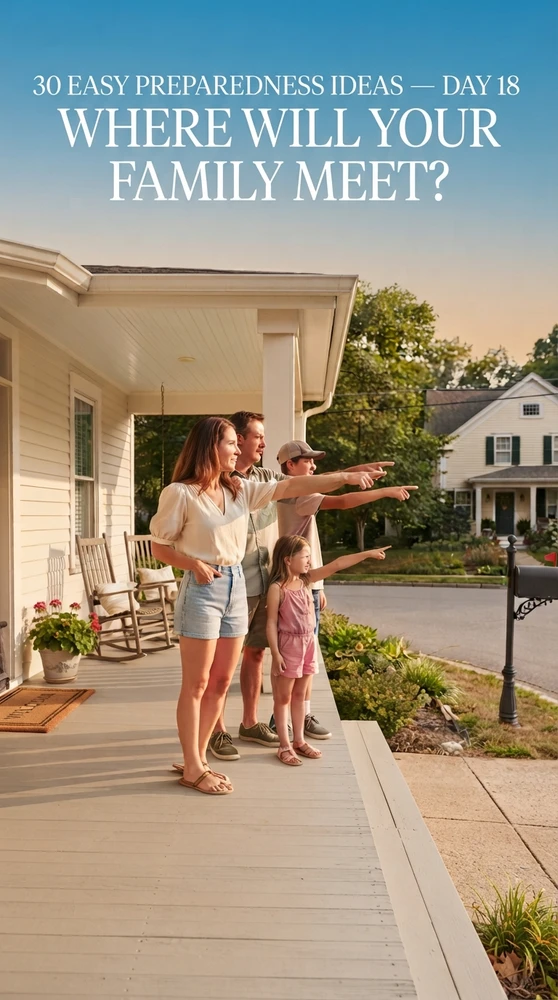
30 EASY PREPAREDNESS IDEAS — DAY 18 WHERE WILL YOUR FAMILY MEET?
Posted by Mimi on Sep 18th 2026
30 EASY PREPAREDNESS IDEAS — DAY 18
WHERE WILL YOUR FAMILY MEET?
Welcome to Day 18 of our 30 Easy Preparedness Ideas!
Yesterday we learned:
ALWAYS HAVE A PLAN B.
We found two ways out of our home and two possible routes out of our neighborhood.
But that brings us to another really important question:
ONCE EVERYONE GETS OUT...WHERE DO WE MEET?
Think about it.
Mom goes out the front door.
Dad goes out the back.
One child was already outside.
An older child climbed out through another safe exit.
Everyone is out...
BUT NOBODY KNOWS WHERE ANYONE ELSE IS.
That's a problem.
So today's challenge is another one that doesn't require a shopping trip.
We're going to choose:
TWO FAMILY EMERGENCY MEETING PLACES.
ONE CLOSE TO HOME
AND
ONE OUTSIDE YOUR IMMEDIATE NEIGHBORHOOD
Simple.
Specific.
Easy to remember.
Let's do it!
WHY DO WE NEED A MEETING PLACE?
During an emergency, family members may not all be together.
Someone may be:
- At home
- At school
- At work
- At the store
- Driving
- Visiting a neighbor
- Walking the dog
Even when everyone starts at home, they may leave through different exits.
A designated meeting place gives everyone the same answer to:
“WHERE DO I GO?”
Instead of everyone wandering around looking for one another, the family has a plan.
MEETING PLACE #1 — CLOSE TO HOME
Your first meeting place should be somewhere outside and a safe distance from your home that everyone can easily recognize.
This is especially important for something like a house fire.
Depending on your property, it might be:
- A specific mailbox
- A particular tree
- A trusted neighbor's property
- A nearby landmark
- Another clearly identified safe location
The important part isn't WHAT you choose.
The important part is:
EVERYONE CHOOSES THE SAME PLACE.
Don't say:
“Meet somewhere out front.”
That's too vague.
Instead:
“WE MEET BY MRS. SMITH'S MAILBOX ACROSS THE STREET.”
Now everyone knows exactly where to go.
Of course, choose a location that doesn't require children to cross a dangerous roadway or move toward the hazard.
WHY THIS MATTERS DURING A FIRE
Remember what we talked about yesterday?
GET OUT AND STAY OUT.
Your meeting place helps with the STAY OUT part.
If Mom gets outside and can't find one of the kids, her instinct may be:
“MY CHILD IS STILL INSIDE!”
But what if that child actually exited through another door and is standing around the side of the house?
That's why everyone needs to know:
GET OUT.
GO TO THE MEETING PLACE.
STAY THERE.
Once outside, don't go back into a burning building to look for another person or pet.
Tell firefighters if someone or an animal may still be inside.
TEACH THE KIDS
Today's challenge is PERFECT for kids.
Walk outside together.
Actually stand at your chosen meeting place.
Then tell them:
“IF WE HAVE TO GET OUT OF THE HOUSE, THIS IS WHERE OUR FAMILY MEETS.”
Have them repeat it.
Better yet...
Make them show YOU.
Ask:
“WHERE'S OUR MEETING PLACE?”
Let them lead you there.
Kids don't need a complicated emergency-management lecture.
They need a simple instruction they can remember.
GET OUT.
GO HERE.
WAIT FOR US.
MIMI'S TIP: GIVE THE SPOT A NAME
Make the meeting place easy to remember.
Maybe your family calls it:
THE BIG TREE
THE MAILBOX
GRANDMA'S DRIVEWAY
THE STOP SIGN
Whatever works for your family.
If a five-year-old can remember it, we're doing pretty well.
MEETING PLACE #2 — OUTSIDE YOUR NEIGHBORHOOD
Now we need a second meeting place.
This one is for a different kind of situation.
What if you can't safely return home?
Or your neighborhood has been evacuated?
Or family members are in different places when something happens?
Choose a familiar location outside your immediate neighborhood where your family could reconnect if local conditions allow.
It might be:
- A relative's home
- A trusted friend's home
- A familiar community location
- Another well-known location
- Another safe, easily recognized place
Choose somewhere everyone knows how to identify.
And think about whether the location would realistically be accessible to your family.
DON'T MAKE THE PLAN TOO COMPLICATED
We can turn preparedness plans into something that looks like a military operation pretty quickly.
Today we're keeping it simple.
IF WE HAVE TO LEAVE THE HOUSE:
WE MEET HERE.
IF WE CAN'T RETURN TO OUR NEIGHBORHOOD:
WE MEET HERE.
That's enough for today's challenge.
You can build more details into your family emergency plan later.
REMEMBER DAY 13?
We made our Emergency Contact Card!
Here's where that little piece of paper becomes even more useful.
Your card already includes important phone numbers and your out-of-area contact.
Now add your meeting-place information.
For example:
HOME MEETING PLACE:
Big tree across from our driveway
NEIGHBORHOOD MEETING PLACE:
Aunt Mary's house
Now everyone has the information in writing.
Put updated copies in:
- Grab-N-Go Bags
- Wallets or purses
- Vehicle emergency kits
- Children's bags when appropriate
- Your household emergency information
See how all these little preparedness projects are starting to connect?
HAVE AN OUT-OF-AREA CONTACT TOO
This isn't necessarily another physical meeting place, but it's worth reviewing today.
Remember the out-of-area contact we talked about on Day 13?
If family members become separated, that person can serve as a communication point.
For example:
Mom reaches the contact.
Dad reaches the contact.
An older child reaches the contact.
Now there's someone outside the immediate situation who may be able to help family members reconnect.
Make sure that person knows you've chosen them.
Don't surprise poor Aunt Susan during an emergency with:
“CONGRATULATIONS! YOU'RE OUR FAMILY COMMUNICATION CENTER!”
Talk about the plan ahead of time.
WHAT IF CELL SERVICE ISN'T WORKING WELL?
Our phones are wonderful tools.
But emergencies can affect power and communication networks.
That's another reason we're creating a plan before something happens.
If everyone already knows:
- Where to meet
- Who the out-of-area contact is
- What the family plan is
We aren't depending entirely on one phone call getting through.
Keep the paper Emergency Contact Card as a backup.
PAPER DOESN'T NEED A CHARGER.
WHAT ABOUT SCHOOL AND WORK?
Here's another good family conversation.
What happens if an emergency occurs while everyone is separated?
Parents should know the emergency and reunification procedures for their children's school or childcare provider.
Adults should also consider workplace emergency procedures.
Don't automatically tell children to leave school and travel to the family meeting place.
FOLLOW THE SCHOOL'S EMERGENCY AND REUNIFICATION PROCEDURES.
The goal is for the whole family to understand that different situations may require different actions.
DON'T FORGET THE PET PLAN
Because you KNOW Mimi isn't forgetting the animals.
If you're evacuating your home and it's safe to take them:
- Grab the leash
- Grab the carrier
- Grab the Pet Grab-N-Go Bag from Day 8
And think about your second meeting location.
ARE PETS ALLOWED THERE?
If your plan is to meet at a relative's home, make sure that relative knows your four-legged family members may be coming too.
Planning ahead prevents another problem later.
CONNECT THIS TO YESTERDAY'S PLAN B
Yesterday we found alternate routes out of our neighborhood.
Today ask:
“CAN WE REACH OUR SECOND MEETING PLACE USING MORE THAN ONE ROUTE?”
Maybe Route A works.
Maybe it doesn't.
Is there another way?
You don't need to memorize every street in town.
Just start becoming familiar with your options.
Yesterday's challenge and today's challenge work together:
DAY 17: HOW DO WE GET OUT?
DAY 18: WHERE DO WE GO?
Now we're building an actual family evacuation plan.
HAVE A 10-MINUTE FAMILY MEETING
Tonight, gather everyone together.
This does NOT need to become a two-hour emergency planning seminar.
Mimi promises.
Take ten minutes.
Tell everyone:
“THIS IS OUR MEETING PLACE IF WE HAVE TO GET OUT OF THE HOUSE.”
Then:
“THIS IS OUR MEETING PLACE IF WE CAN'T COME BACK TO OUR NEIGHBORHOOD.”
Review your out-of-area contact.
Then ask the kids to tell YOU the plan.
You'll quickly discover what they remember and what needs another explanation.
MAKE IT A GAME
For younger kids, turn it into another preparedness challenge.
Ask:
“MIMI SAYS...GO TO THE FAMILY MEETING PLACE!”
Let them walk there.
Then come back inside and ask again later.
“WHERE DO WE GO IF WE HAVE TO GET OUT?”
If they can point to it or tell you...
WIN!
Preparedness doesn't have to frighten children.
It can simply become:
“THIS IS WHAT OUR FAMILY DOES.”
MIMI'S TIP: PRACTICE IT IN DAYLIGHT FIRST
Choose and practice your meeting place when everyone can clearly see where they're going.
Then another day, consider asking:
“COULD WE FIND THIS PLACE AT NIGHT?”
Is the path safe?
Would everyone recognize it?
Would you need a flashlight?
Remember Day 1?
Shoes and flashlight by the bed!
And Day 7?
Backup lighting!
Once again...
ALL THESE LITTLE THINGS START WORKING TOGETHER.
TODAY'S EASY PREPAREDNESS CHALLENGE
Today:
☐ Choose a safe meeting place close to home
☐ Take the whole family there
☐ Give the meeting place an easy name
☐ Make sure children know where it is
☐ Remind everyone: GET OUT AND STAY OUT
☐ Choose a second meeting place outside your immediate neighborhood
☐ Make sure everyone knows that location
☐ Review your out-of-area contact from Day 13
☐ Add meeting places to your Emergency Contact Card
☐ Think about pets
☐ Review school/childcare reunification procedures when applicable
☐ Connect the plan to yesterday's alternate evacuation routes
Then ask everyone:
“WHERE DO WE MEET?”
If they know the answer...
Today's challenge worked!
✅ DAY 18 — DONE!
Yesterday we learned:
HOW DO WE GET OUT?
Today we learned:
WHERE DO WE GO?
Two little questions.
Two very important answers.
You didn't need a shopping trip.
You didn't need expensive equipment.
You simply sat down with the people you love and made a plan.
And THAT is preparedness too.
Tomorrow for Day 19, we're going to learn something else every household should know:
WHERE ARE YOUR UTILITY SHUTOFFS?
Water.
Natural gas, if your home has it.
Electricity.
We're going to find them and learn about them—
NOT randomly shut everything off to practice!
Until tomorrow...
ONE LITTLE THING AT A TIME.
— Mimi
PackFreshUSA | 30 Easy Preparedness Ideas