
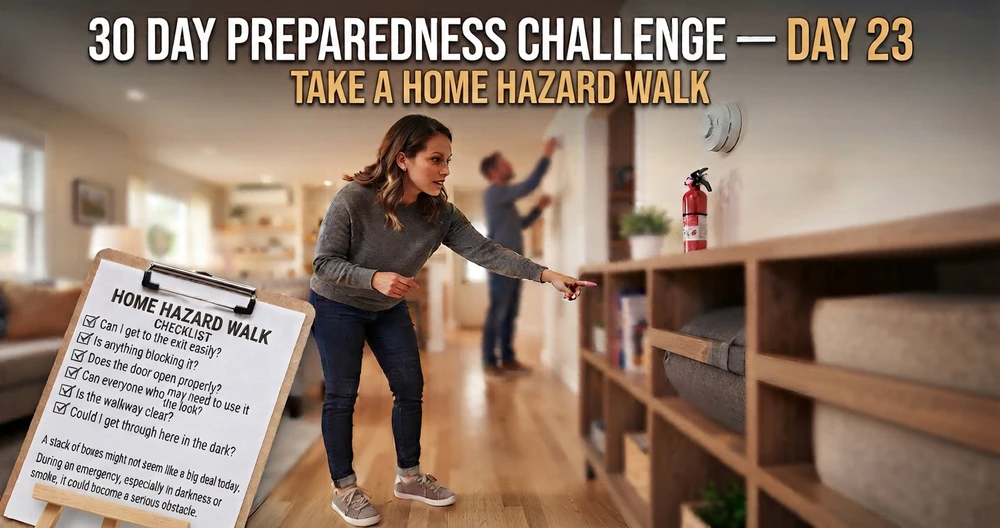
30 DAY PREPAREDNESS CHALLENGE — DAY 23 TAKE A HOME HAZARD WALK
Posted by Mimi on Sep 23rd 2026
30 DAY PREPAREDNESS CHALLENGE — DAY 23
TAKE A HOME HAZARD WALK
WHAT AROUND YOUR HOME COULD BECOME A PROBLEM DURING AN EMERGENCY?
Welcome to Day 23!
Today's preparedness challenge isn't going to cost you anything.
You don't need to order anything.
You don't need another emergency tote.
And Mimi is NOT asking you to reorganize the entire garage.
Today we're simply going to:
WALK THROUGH OUR HOMES WITH “EMERGENCY EYES.”
Because sometimes the things that can make an emergency harder are things we walk past every single day.
That tall bookshelf.
The heavy picture hanging over the bed.
The boxes sitting in front of the back door.
The extension cord stretched across the walkway.
The stuff piled on the stairs.
You know...
The thing you've looked at approximately 4,782 times and thought:
“I really need to do something about that.”
Today we're finally looking at it.
TODAY'S CHALLENGE
Take 10–15 minutes and walk through your home.
Don't worry about fixing everything today.
For now:
LOOK.
NOTICE.
FIX THE EASY THINGS.
MAKE A LIST OF THE REST.
We're asking one simple question:
“COULD THIS BECOME A PROBLEM DURING AN EMERGENCY?”
START WITH YOUR EXITS
Remember Day 17 — Know Two Ways Out?
Let's check those routes again.
Walk to your:
- Front door
- Back door
- Side door
- Garage exit
- Appropriate emergency windows
Ask:
✔️ Can I get to the exit easily?
✔️ Is anything blocking it?
✔️ Does the door open properly?
✔️ Can everyone who may need to use it operate the lock?
✔️ Is the walkway clear?
✔️ Could I get through here in the dark?
A stack of boxes might not seem like a big deal today.
During an emergency, especially in darkness or smoke, it could become a serious obstacle.
KEEP YOUR EXIT ROUTES CLEAR.
And remember from Day 17:
If there is a fire, GET OUT AND STAY OUT.
NOW LOOK DOWN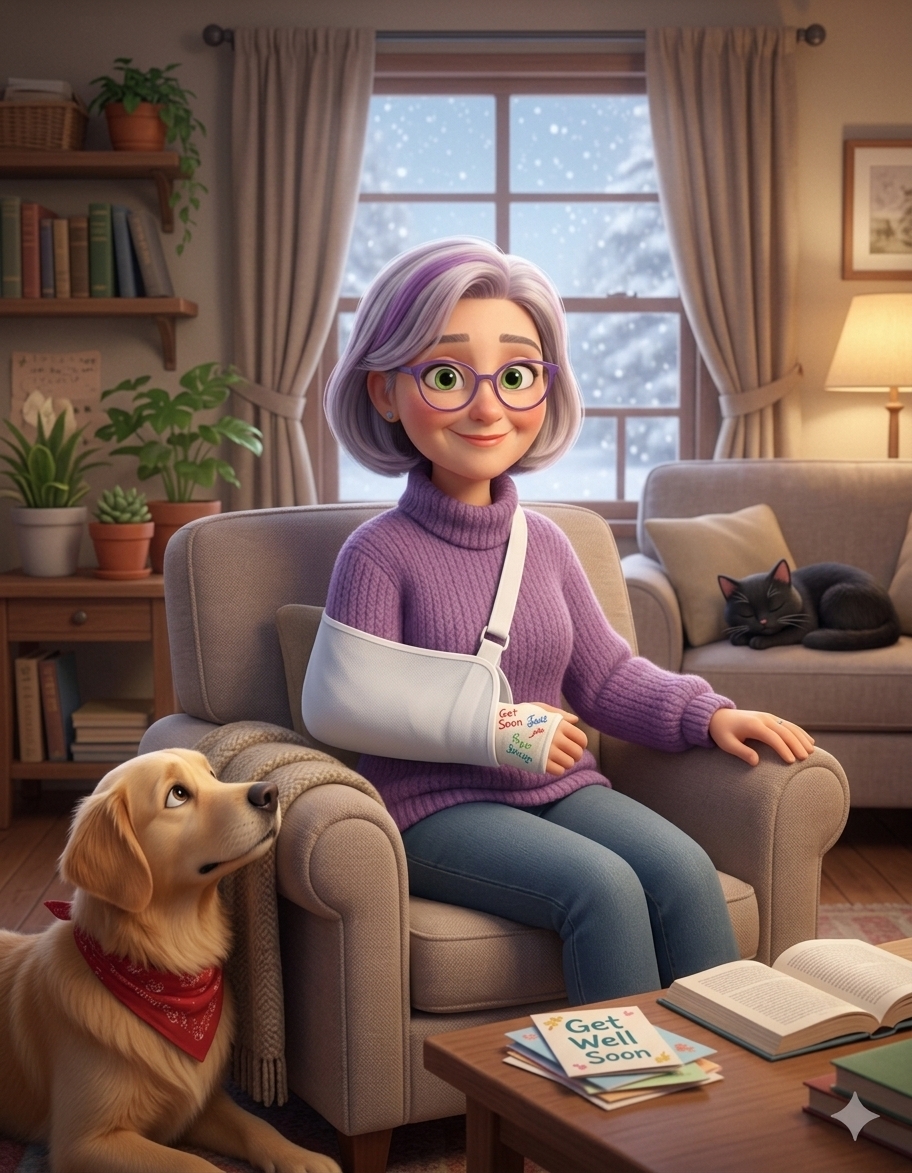
Some hazards aren't above us.
They're under our feet.
Look for:
- Shoes left in walkways
- Toys
- Electrical cords
- Boxes
- Laundry baskets
- Pet toys
- Furniture sticking into pathways
- Rugs that slide, curl or bunch
Think about what would happen if the power went out tonight.
Could you safely walk from your bedroom to your emergency light?
Could a child?
Could an older family member?
Could YOU do it if you were injured?
And considering Mimi is currently discovering what life is like with a broken wrist...
THAT LAST QUESTION JUST BECAME A LOT MORE INTERESTING. ?
Emergencies don't always happen when we're at our strongest.
LOOK UP — WHAT COULD FALL?
Now look at the things around you that could fall or shift.
Check:
- Tall bookshelves
- Cabinets
- Televisions
- Large mirrors
- Heavy pictures
- Heavy decorations
- Breakable objects
- Heavy storage items
Pay particular attention to things near:
- Beds
- Places people sit
- Cribs
- Children's beds and play areas
- Doorways and exits
Ask:
“IF THIS FELL, WHERE WOULD IT LAND?”
That's a surprisingly useful question.
If something heavy or unstable concerns you, add it to your list to secure, relocate, or have properly anchored.
Follow the manufacturer's instructions for securing furniture, televisions, shelving and other items.
TAKE A GOOD LOOK AROUND THE BED
We've already talked about keeping easy slip-on shoes and a flashlight beside the bed on Day 1.
Now look ABOVE and AROUND your sleeping area.
Is there:
A heavy picture over the bed?
A large mirror?
A shelf holding heavy objects?
Something breakable?
Furniture that could block your path to the door?
We spend a lot of hours sleeping.
Make sure the area around the bed isn't creating unnecessary hazards.
GET DOWN TO KID LEVEL
If you have children in your home, look at the room from their perspective.
What can they:
Pull over?
Climb?
Reach?
Trip over?
Open?
Knock down?
Children aren't just tiny adults.
Their height, curiosity and ability to understand danger are different.
Today's walk-through is a great family activity.
Ask the kids:
“CAN YOU FIND SOMETHING THAT MIGHT BE IN OUR WAY IF THE LIGHTS WENT OUT?”
You might be surprised by what they notice!
THINK ABOUT MOBILITY TOO
Preparedness needs to work for the people who actually live in the house.
Think about:
- Older adults
- Someone using mobility equipment
- Small children
- Someone temporarily injured
- Someone who needs glasses to see well
- Pets underfoot
A pathway that is easy for one person may be difficult for another.
And sometimes our abilities change unexpectedly.
Trust me.
BROKEN-WRIST MIMI HAS ENTERED THE CHAT.
This is exactly why we practice preparedness before we need it.
TRY LOOKING AT YOUR HOUSE IN THE DARK
You don't have to turn the entire house pitch black.
But think about your normal nighttime pathways.
Bedroom → bathroom.
Bedroom → children's room.
Bedroom → exit.
Living room → flashlight.
Would you know where you're going?
Remember our earlier challenges:
Day 1: Shoes + flashlight by the bed.
Day 7: Charge your backup power and emergency lights.
Those little preparations start working together.
LOOK AROUND YOUR COOKING AREA
The kitchen deserves its own quick look.
Check that:
✔️ Flammable clutter isn't unnecessarily close to cooking surfaces.
✔️ Your fire extinguisher from Day 5 is accessible.
✔️ You know where your fire blanket is if you have one.
✔️ You aren't storing things where they could easily fall onto cooking equipment.
✔️ Walkways and exits remain clear.
And remember our Day 5 rule:
NEVER POUR WATER ON A GREASE OR OIL FIRE.
If a fire grows, produces heavy smoke, blocks your exit, or you aren't sure you can handle it safely:
GET OUT. STAY OUT. CALL 911.
NOTICE YOUR ELECTRICAL AREAS
We're not doing electrical repairs today.
We're simply LOOKING.
Notice things such as:
- Damaged cords
- Loose or damaged plugs
- Cords creating trip hazards
- Overloaded-looking power setups
- Extension cords being used in questionable ways
If something doesn't look safe, don't improvise an electrical repair.
Follow manufacturer guidance or have a qualified professional evaluate it when appropriate.
Remember Day 19?
We already found our electrical panel and main disconnect.
Today we're simply noticing possible hazards around the house.
DON'T FORGET THE GARAGE
Oh, the garage.
Also known as:
THE LAND OF “I'LL PUT THIS AWAY LATER.”
Take a quick look.
Can you reach the exit?
Can you reach your emergency supplies?
Can you reach your water?
Can you get to your Grab-N-Go Bags?
Are heavy objects stored securely?
Could something fall into your walkway?
Are household chemicals stored according to their labels and away from children and pets?
You don't have to clean the garage today.
I PROMISE.
We're just identifying problems.
LOOK AT HOUSEHOLD CHEMICALS
Cleaning products, fuels and other household chemicals should be stored according to their labels.
Check that containers are:
✔️ Closed properly
✔️ Clearly labeled
✔️ Not leaking
✔️ Stored appropriately
✔️ Away from children and pets
Don't transfer chemicals into food or drink containers.
And remember from yesterday:
NEVER MIX CLEANING CHEMICALS UNLESS THE LABEL SPECIFICALLY SAYS IT IS SAFE.
AND THEN THERE ARE THE PETS...
Pets have a special talent for leaving things exactly where humans are going to step.
Check:
- Leashes aren't creating trip hazards.
- Toys aren't blocking pathways.
- Carriers are accessible.
- Pet emergency supplies can be reached.
Remember Day 8—our Pet Grab-N-Go Bag.
During an emergency, you don't want to search the entire house for the cat carrier.
And anyone who owns a cat knows:
THE CAT WILL ALREADY KNOW SOMETHING IS HAPPENING AND WILL DISAPPEAR INTO ANOTHER DIMENSION.
Know where that carrier is!
MIMI'S RULE: DON'T TURN THIS INTO A HUGE PROJECT
This is important.
You may walk around your house and suddenly discover:
27 THINGS YOU WANT TO FIX.
Don't let that overwhelm you.
Remember what we've been saying all month:
ONE LITTLE THING AT A TIME.
Today:
FIX ONE EASY THING.
Move the box.
Pick up the cord.
Clear the doorway.
Move the heavy decoration.
Put the flashlight where it belongs.
Then write down anything that needs more time.
That's preparedness too.
MAKE A “FIX LATER” LIST
Some things may require:
- Tools
- Supplies
- Professional help
- More time
- Money
That's okay.
Write them down.
Maybe your list says:
☐ Secure tall bookshelf
☐ Move heavy picture above bed
☐ Fix loose rug
☐ Replace damaged cord
☐ Clear garage exit
☐ Move heavy storage boxes lower
☐ Secure television
☐ Relocate household chemicals
Now those things aren't just thoughts floating around in your head.
YOU HAVE A PLAN.
TODAY'S 10-MINUTE CHALLENGE
Walk through your home and check:
☐ Front and back exits are clear
☐ Your second escape route from Day 17 is accessible
☐ Hallways and stairs are clear
☐ Floors are free of obvious trip hazards
☐ Rugs are secure
☐ Heavy items aren't hanging dangerously over beds/seating
☐ Tall furniture appears stable
☐ Heavy storage items aren't likely to fall
☐ Children's areas are checked from kid level
☐ Emergency lights are accessible
☐ Fire extinguisher is accessible
☐ Electrical cords don't create obvious hazards
☐ Household chemicals are properly stored
☐ Emergency supplies are accessible
☐ Pet carrier/leash can be reached quickly
☐ You identified anything that needs a bigger fix
And then...
FIX ONE THING TODAY.
That's it.
DAY 23 — DONE!
Today's preparedness challenge didn't require a shopping trip.
It didn't require expensive emergency gear.
You simply looked at your home differently.
And maybe you moved a box.
Secured a rug.
Cleared a doorway.
Moved something heavy.
Or finally dealt with that thing you've walked past 4,782 times.
Small changes can make our homes safer and make our emergency plans easier to use.
Because preparedness isn't always about what we ADD.
Sometimes...
IT'S ABOUT MOVING SOMETHING OUT OF THE WAY.
One little thing at a time.
— Mimi
PackFreshUSA
TOMORROW — DAY 24
We've been storing emergency food.
We've been planning meals.
We've been checking our pantry.
Tomorrow we're going to do something VERY important:
WE'RE ACTUALLY GOING TO EAT IT.
Day 24: Make an Emergency-Pantry Meal
No special shopping trip.
Use what you already have and find out whether your emergency food plan actually works!